



The State of the Pressure Washing Industry in 2026: Market Analysis, Growth Trends, and What's Ahead
|
|
Time to read 18 min
|
|
Time to read 18 min
The pressure washing industry has entered a new phase of maturity in 2026, marked by heightened competition, rising operational costs, and a clear divide between professional operators and part-time newcomers. With an estimated 68,000 to 75,000 active pressure washing contractors now operating across the United States—up from approximately 62,000 in 2024—the exterior cleaning market continues to grow even as profit margins compress and business failure rates climb. For contractors, investors, and suppliers navigating this evolving landscape, understanding the forces reshaping the industry has never been more critical.
This comprehensive analysis examines the current state of the pressure washing and soft washing sectors, drawing on recent market data, economic indicators, and observable trends within the home services industry. From customer acquisition costs that have doubled in some markets to the technological shifts transforming marketing and operations, 2026 presents both significant opportunities and formidable challenges for exterior cleaning businesses.
The U.S. pressure washing industry generated an estimated $2.1 to $2.3 billion in revenue in 2025, according to IBISWorld's latest home services market analysis. This figure represents the combined output of residential and commercial exterior cleaning services, including traditional pressure washing, soft washing, roof cleaning, and related surface treatment services.
Determining the precise number of active pressure washing contractors remains challenging due to the industry's fragmented nature and low barriers to entry. However, triangulating data from the U.S. Census Bureau's Nonemployer Statistics, Small Business Administration licensing data, and industry supplier estimates suggests that between 68,000 and 75,000 businesses currently identify pressure washing as a primary or secondary service offering.
This contractor population breaks down roughly as follows:
Solo operators and part-time contractors: 45,000-50,000 (approximately 65-67% of total)
Small businesses with 1-5 employees: 18,000-20,000 (approximately 26-28%)
Mid-sized operations with 6+ employees: 4,000-5,000 (approximately 5-7%)
Large regional or multi-location companies: 300-500 (less than 1%)
The concentration of solo and part-time operators significantly influences industry dynamics, contributing to price volatility, service quality inconsistencies, and high churn rates that define the current market environment.
Industry growth has moderated compared to the explosive expansion seen during 2020-2022, when pandemic-driven demand for outdoor home improvements and low startup costs attracted record numbers of new entrants. Current projections suggest 2026 will see revenue growth of 3.2% to 4.1%, slightly below the 4.8% growth recorded in 2025.
This deceleration reflects several converging factors: housing market cooling in key regions, increased competition compressing per-job pricing, and higher business failure rates among undercapitalized operators. However, demand fundamentals remain strong, supported by aging housing stock, growing awareness of exterior maintenance benefits, and expanding commercial property management sectors requiring regular cleaning services.
The contractor population growth rate has similarly slowed. While 2024 saw net additions of approximately 8,000 new businesses (after accounting for closures), 2025 added roughly 6,000, and 2026 projections suggest 4,000-5,000 net new entrants. This cooling reflects both market saturation signals and increased awareness of the challenges facing new operators.
Market saturation varies dramatically by geography, making blanket statements about industry crowding misleading. Metropolitan areas in the Southeast, Southwest, and parts of the Mid-Atlantic have experienced particularly intense contractor growth, while rural markets and certain Midwest regions remain comparatively underserved.
Data analysis of contractor density per capita reveals stark regional differences:
High-saturation markets (Florida, Georgia, North Carolina, Texas, Arizona): These states now average one pressure washing contractor per 3,000-4,500 residents in metropolitan areas. In cities like Atlanta, Charlotte, Tampa, and Phoenix, competition has intensified to the point where customer acquisition costs frequently exceed first-job revenue for new operators without established marketing systems.
Moderate-saturation markets (Virginia, South Carolina, Tennessee, California, Nevada): Averaging one contractor per 5,000-7,000 residents, these markets present more balanced supply-demand dynamics while still offering growth opportunities for differentiated operators.
Lower-saturation markets (Much of the Midwest, Northeast, and Northwest): Markets in Ohio, Pennsylvania, Michigan, Illinois, and Pacific Northwest states generally show one contractor per 8,000-12,000 residents, though seasonal constraints and weather patterns affect annual revenue potential.
Beyond simple contractor counts, competition intensity manifests in several measurable ways:
Google Local Service Ads costs: The average cost-per-lead for pressure washing services through Google's platform has increased 43% since early 2024, now ranging from $18-$35 in competitive markets compared to $12-24 eighteen months ago. This reflects both increased advertiser density and Google's algorithmic adjustments to maximize platform revenue.
SEO difficulty: Ranking for local "pressure washing near me" and related search terms now requires substantially more effort and expertise. Markets that previously allowed new businesses to achieve first-page rankings within 60-90 days now frequently require 6-12 months of consistent optimization, content creation, and review generation.
Customer acquisition timelines: Average time-to-first-job for new contractors has extended from 2-3 weeks in 2022-2023 to 4-8 weeks in 2026, reflecting the increased difficulty of breaking through market noise and establishing initial credibility.
The pressure washing industry experiences significantly higher business failure rates than home services sectors with greater capital requirements and regulatory barriers. While precise failure tracking remains limited, available data paints a sobering picture.
Analysis of Small Business Administration data for NAICS code 561790 (Services to Buildings and Dwellings, which includes pressure washing) combined with industry-specific observations suggests that 35-42% of new pressure washing businesses cease operations within their first year, with cumulative two-year failure rates reaching 52-58%.
These failure rates substantially exceed the often-cited statistic that "20% of small businesses fail in their first year." The pressure washing industry's elevated churn stems from several structural factors:
Inadequate capitalization: The industry's low barrier to entry—equipment can be acquired for $3,000-$8,000—paradoxically contributes to high failure rates. Undercapitalized operators frequently lack sufficient reserves to sustain marketing expenses, weather slow periods, or handle equipment failures. The SBA recommends service businesses maintain 6-9 months of operating expenses in reserve; most new pressure washing contractors operate with less than 30 days of cash reserves.
Marketing cost underestimation: New operators consistently underestimate customer acquisition costs, expecting word-of-mouth and free marketing channels to generate sufficient leads. In 2026's competitive environment, sustainable lead generation typically requires monthly marketing investments of $800-$2,500, a figure that shocks operators who expected to rely primarily on yard signs and social media posts.
Pricing failures: Inexperienced contractors frequently underprice services to win initial jobs, creating unsustainable business models. Industry analysis suggests that at least 40% of new operators price jobs below their true cost-per-hour when properly accounting for equipment depreciation, insurance, marketing, fuel, and time costs. This leads to a cycle where increasing job volume paradoxically worsens financial position.
Seasonal cash flow management: Contractors in seasonal markets who fail to properly budget for 3-5 months of reduced or zero revenue face predictable financial crises. First-year operators are particularly vulnerable, having not yet experienced a full seasonal cycle.
Lack of business systems: The technical simplicity of pressure washing creates a false impression that business success requires only equipment and effort. Operators who lack systems for estimating, scheduling, customer communication, and financial management quickly become overwhelmed as job volume increases.
Contractors who successfully navigate their first year face substantially improved long-term prospects. Businesses reaching their second anniversary demonstrate two-year-plus survival rates of approximately 68-73%, suggesting that initial market establishment represents the critical challenge.
Successful first-year navigation correlates strongly with several factors: starting with at least $15,000 in working capital beyond equipment costs, having prior sales or marketing experience, operating in markets with contractor density below 1 per 6,000 residents, and establishing minimum pricing floors that ensure positive unit economics from initial jobs.
The pressure washing industry's commercial and residential segments present distinctly different business models, economics, and competitive dynamics.
Residential pressure washing jobs in 2026 average $275-$425 per appointment, depending on service scope and regional pricing. Standard house washes typically range from $250-$500, with additional services for driveways, decks, and specialty treatments adding incremental revenue. Time-per-job averages 2-4 hours including travel, with experienced operators targeting $100-$150 per hour in gross revenue.
Commercial pressure washing presents substantially different economics. Average commercial job values range from $850 to $3,500, with larger contracts for retail centers, multifamily properties, and industrial facilities reaching $5,000-$25,000+. However, these higher ticket values come with different cost structures: longer payment cycles (30-60 days vs. immediate residential payment), lower per-square-foot pricing, higher insurance requirements, and often more complex bidding processes.
Residential work comprises approximately 62-67% of total industry revenue, with commercial contracts representing 33-38%. However, these percentages vary significantly by operator size. Solo contractors and small businesses derive 75-85% of revenue from residential clients, while larger operators with dedicated commercial divisions often generate 50-65% of revenue from commercial contracts.
The commercial market has proven more resistant to commoditization and price competition. Property managers and facility directors prioritize reliability, insurance coverage, and professional operations over lowest-bid pricing, creating opportunities for established operators to command premium rates. However, commercial contract acquisition requires different capabilities: professional proposals and estimates, relationship development with property managers, proper licensing and insurance documentation, and capacity to handle larger-scale projects.
In 2026, successful pressure washing businesses increasingly adopt hybrid models, using residential work to generate consistent cash flow and fill schedule gaps while pursuing commercial contracts that provide larger revenue events and more stable annual relationships.
Profit margins across the pressure washing industry have compressed in 2026 as operational costs have risen faster than contractors' ability to increase pricing in competitive markets.
Customer acquisition cost (CAC) represents one of the most significant margin pressures facing pressure washing contractors. In competitive markets, the fully-loaded cost to acquire a new residential customer—including paid advertising, website and SEO maintenance, review management, proposal time, and marketing attribution—now ranges from $85 to $180.
This represents a dramatic increase from 2023-2024 figures of $45-$95, with the escalation driven by several factors:
Paid advertising inflation: Google Ads cost-per-click for pressure washing related terms has increased 38-52% since 2024 in major markets. Contractors now pay $8-$25 per click in competitive areas, with conversion rates from click to booked job averaging just 3-8%. This yields cost-per-acquisition through paid search of $125-$300 before factoring in non-converting leads and cancellations.
SEO and content marketing requirements: Achieving organic visibility now requires sustained investment in website optimization, content creation, and local SEO management. Contractors either invest 10-15 hours monthly managing these efforts internally or pay $500-$1,500 monthly for professional services. When distributed across monthly customer acquisition, these costs add $35-$75 per customer.
Review generation and reputation management: Maintaining the review velocity and rating necessary for local search visibility requires systematic post-job follow-up and often review management software ($50-$150 monthly). The time and system costs associated with review generation add an estimated $15-$25 per customer acquired.
Lead aggregator platforms: Many contractors supplement direct marketing with leads from HomeAdvisor, Angi, Thumbtack, and similar platforms, where lead costs range from $18-$65 per lead with close rates of 15-35%, yielding acquisition costs of $50-$200.
These elevated acquisition costs fundamentally change business economics. A $300 residential job with $100 in direct costs (labor, chemicals, fuel, equipment depreciation) and $140 in customer acquisition costs leaves just $60 in contribution margin—before accounting for insurance, business overhead, and owner compensation. This math explains why many new operators struggle to achieve profitability despite staying busy.
Established contractors with strong repeat and referral business maintain lower blended acquisition costs of $35-$70, illustrating the critical importance of customer retention and referral systems for long-term profitability.
Equipment costs have risen moderately but consistently since 2024. Professional-grade pressure washers, surface cleaners, and related equipment have increased 8-12% over eighteen months, reflecting broader inflation in manufacturing and supply chain costs. A professional startup equipment package that cost $4,500-$6,000 in early 2024 now requires $5,000-$6,700.
More significantly, chemical and supply costs have risen 15-22% since 2024. Sodium hypochlorite (bleach), surfactants, and specialty cleaners have all experienced price increases driven by raw material costs and manufacturing consolidation. Per-job chemical costs for a typical house wash have increased from $8-$12 to $11-$16, a meaningful margin impact when multiplied across hundreds of annual jobs.
Equipment maintenance and replacement cycles have also compressed. The increased complexity of modern pressure washing equipment—variable pressure systems, chemical injection technology, advanced surface cleaners—has created higher repair costs and slightly reduced equipment lifespans. Contractors report average equipment replacement cycles of 2,500-3,500 hours compared to 3,000-4,500 hours for simpler equipment generations, increasing annual depreciation expenses.
Pressure washing businesses attempting to scale beyond owner-operator models face significant labor acquisition and retention challenges in 2026. The broader labor market dynamics affecting all home services industries—tight employment, wage inflation, competition from other sectors—manifest acutely in pressure washing due to several factors:
Wage pressure: Entry-level pressure washing technicians now command $16-$22 per hour in most markets, compared to $13-$17 eighteen months ago. Experienced technicians with customer interaction skills and technical proficiency in soft washing command $20-$28 per hour. These wages approach or exceed compensation for less physically demanding service roles, making recruitment challenging.
High turnover: The industry experiences annual employee turnover rates estimated at 65-85%, well above the home services industry average of 45-55%. The physical demands, weather exposure, and often irregular scheduling contribute to retention challenges.
Training investment risk: Bringing an employee to full productivity requires 3-6 weeks of training, during which productivity suffers and supervision intensity increases. With turnover rates exceeding 65%, many small operators face repeated training cycles that drain resources without building stable capacity.
These labor challenges have contributed to industry bifurcation: successful scaling operations invest heavily in employee systems, compensation above market rates, and operational processes that reduce physical demands and improve job satisfaction, while many contractors remain intentionally owner-operator or small team businesses to avoid labor management complexity.
The marketing landscape for pressure washing businesses has transformed dramatically over the past 24 months, with technology adoption and platform algorithm changes reshaping how contractors acquire customers.
Local search optimization has become simultaneously more critical and more complex. Google's search algorithm updates throughout 2025 and early 2026 have further emphasized experience, expertise, authoritativeness, and trustworthiness (E-E-A-T) signals, making sophisticated content marketing and local SEO strategies essential for organic visibility.
The baseline requirements for competitive local search rankings now include:
Website with 15-30+ pages of original, locally-relevant content
Consistent publication of blog content, project showcases, or educational resources
50-100+ Google reviews with ongoing monthly review generation
Comprehensive Google Business Profile optimization with weekly posts
Local citation consistency across 40-60+ business directories
Mobile-optimized website with Core Web Vitals scores meeting Google's thresholds
Structured data markup and technical SEO implementation
This elevated complexity has created a clear divide between contractors who treat marketing as a core business function worthy of significant investment and those who maintain minimal online presence. The former group increasingly dominates local search results and organic lead generation, while the latter face growing dependence on paid advertising or lead aggregator platforms.
Review velocity and overall rating have emerged as perhaps the single most influential local ranking factor in 2026. Analysis of local search results across multiple markets reveals that businesses ranking in the top three local pack positions average 125-300+ Google reviews with ratings of 4.7-5.0 stars, and demonstrate consistent new review acquisition of 8-15+ reviews monthly.
This creates a self-reinforcing dynamic: high visibility generates more jobs, producing more review opportunities, which further strengthens rankings. Newer or smaller operators struggle to generate sufficient review velocity to compete, particularly in saturated markets where established competitors have review portfolios built over 5-8+ years.
Some contractors have responded with systematic review generation processes, including post-job automated follow-up sequences, review incentive programs (structured to comply with Google's policies), and integration of review requests into operational workflows. These systems represent a professionalization of marketing that separates growing businesses from stagnant competitors.
Marketing automation, customer relationship management (CRM) platforms, and AI-assisted communication tools have gained significant adoption among mid-sized and larger pressure washing operations in 2026. Software platforms specifically designed for home services businesses now offer:
Automated appointment reminders and follow-up sequences
Review request automation with optimal timing algorithms
Lead qualification and routing systems
Estimate generation and proposal delivery automation
Customer communication templates leveraging AI-assisted writing
Route optimization for efficient scheduling
Integrated payment processing with automated invoicing
Adoption rates vary dramatically by business size. Operations with 3+ employees report adoption rates of 60-75% for at least basic CRM and automation tools, while solo operators show adoption rates of only 15-25%, often citing cost concerns and setup complexity.
However, the competitive advantage conferred by these systems increasingly justifies the investment. Contractors using automation report 25-40% improvements in review generation rates, 15-30% reductions in schedule gaps and routing inefficiency, and 20-35% decreases in payment collection timelines—each translating directly to improved profitability and cash flow.
The industry's technical evolution toward soft washing and chemical-based cleaning represents one of the most significant trends reshaping service delivery and business positioning in 2026.
Soft washing—low-pressure chemical application for cleaning exterior surfaces—has transitioned from specialty service to industry standard for many applications. Current estimates suggest that 65-75% of established pressure washing contractors now offer soft washing services, compared to approximately 45-55% in 2022-2023.
This shift reflects both customer demand evolution and operational advantages. Property owners have become increasingly aware of the damage risks associated with high-pressure washing on certain surfaces, particularly vinyl siding, painted surfaces, and roofing materials. Simultaneously, contractors have recognized that soft washing often delivers superior results with less physical labor and reduced equipment wear.
The service mix for professionally-operated pressure washing businesses in 2026 typically breaks down as:
Soft wash house washing: 40-50% of residential revenue
Traditional pressure washing (concrete, driveways, hardscapes): 25-35%
Roof cleaning: 15-25%
Specialty services (deck restoration, rust removal, commercial work): 10-20%
This represents a substantial shift from the traditional pressure washing dominated service mix of five years ago, with implications for equipment investment, chemical knowledge requirements, and technician training.
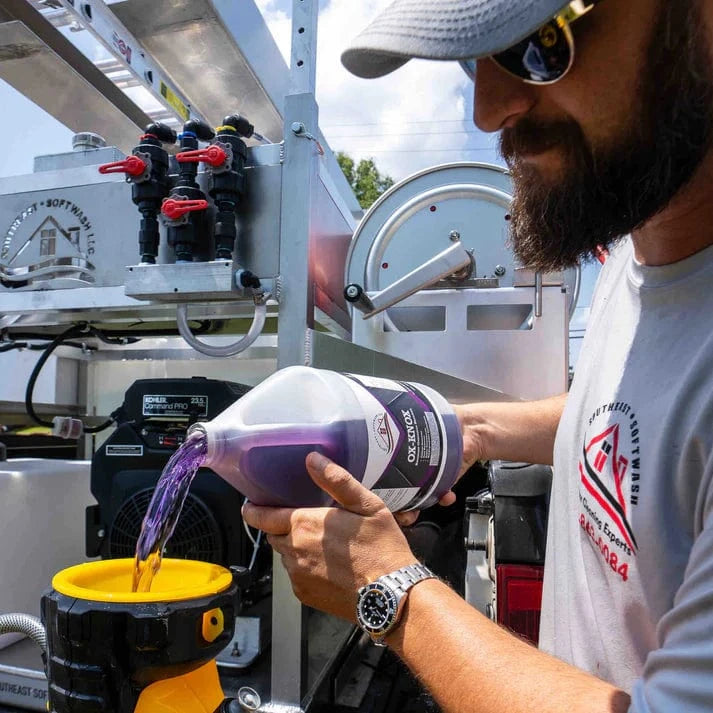
Soft washing expertise has emerged as a key differentiator in competitive markets. Contractors who understand chemical dilution ratios, surfactant selection, dwell time optimization, and surface-specific treatment protocols command premium pricing and attract quality-conscious customers willing to pay more for knowledgeable service.
The technical knowledge gap between professional soft washing operators and traditional pressure washing contractors has widened. Educational resources, certification programs, and specialized training offered by industry organizations and chemical manufacturers have created a professionalization pathway that separates serious operators from competitors treating the business as simple manual labor.
This technical evolution has also influenced customer acquisition, with content marketing around soft washing topics—"what is soft washing," "soft wash vs pressure wash," "roof cleaning methods"—proving highly effective for SEO and customer education. Contractors who successfully communicate technical expertise establish premium positioning that partially insulates them from commoditization and price competition.
The pressure washing industry is experiencing a maturation process characterized by increasing professionalization among leading operators and early-stage consolidation interest from private equity and aggregator companies.
While solo operators continue to comprise the majority of contractors by count, revenue concentration is shifting toward larger, multi-crew operations. Businesses with 3-10+ employees now generate an estimated 35-42% of total industry revenue despite representing less than 10% of contractor count.
These larger operations have invested in operational systems that enable scaling: standardized training programs, documented procedures, quality control processes, fleet management systems, and professional marketing. The result is a two-tier industry: professionalized businesses that operate more like traditional service companies with employee handbooks, safety programs, and operational consistency; and the fragmented majority of small operators running less structured businesses.
The COVID-19 pandemic's impact on home services demand accelerated this professionalization trend, as contractors who successfully scaled during 2020-2022's boom period invested profits into systems and capabilities that now provide sustained competitive advantages.
The pressure washing industry has attracted preliminary interest from private equity-backed home services aggregators and consolidation platforms, though activity remains in early stages compared to more mature sectors like HVAC, plumbing, and pest control.
Several factors drive this emerging interest:
Fragmentation opportunity: With 70,000+ small operators and minimal national or regional consolidation, the industry presents classic roll-up potential for aggregators seeking to acquire and professionalize local businesses.
Recurring revenue potential: Commercial contracts and residential maintenance programs offer predictable revenue streams attractive to financial buyers seeking businesses with recurring cash flow.
Adjacent service expansion: Pressure washing businesses provide logical platforms for adding related exterior services—window cleaning, gutter cleaning, Christmas lighting, lawn care—creating revenue density and cross-selling opportunities.
However, consolidation faces meaningful headwinds. The industry's low barriers to entry ensure continuous new competitor entry, limiting the defensibility that makes other home services sectors attractive. The highly localized, weather-dependent nature of the business complicates regional scaling. And the prevalence of cash-based transactions and informal business practices among smaller operators makes due diligence and acquisition integration challenging.
Despite these obstacles, 2025-2026 has seen several regional multi-unit operators acquired by larger home services platforms, and multiple aggregators have begun building pressure washing divisions through tuck-in acquisitions. This trend is expected to continue, creating potential exit opportunities for established operators who have built professionalized, systematized businesses with documented financials and recurring revenue streams.
Several key trends appear likely to shape the pressure washing industry through late 2026 and into 2027-2028:
Continued margin pressure with widening performance gap: Customer acquisition costs will likely continue rising 8-15% annually as digital marketing competition intensifies, compressing margins for operators who fail to build referral engines and customer retention systems. Simultaneously, the gap between top-performing and average contractors will widen, with professional operators commanding 30-50% price premiums through superior marketing, service quality, and specialization.
Accelerated technology adoption: CRM systems, automation tools, and AI-assisted marketing will transition from competitive advantage to baseline requirement for sustainable operations. Contractors who resist technology adoption will find themselves increasingly disadvantaged in customer acquisition efficiency and operational productivity.
Service diversification and specialization: The middle ground will continue eroding as contractors either diversify into multiple exterior services to maximize revenue per customer or specialize deeply in specific niches (roof cleaning, commercial property, fleet washing, etc.) to establish expertise-based differentiation.
Modest consolidation acceleration: Expect 3-5 significant aggregator acquisitions or multi-unit operator transactions annually through 2027-2028, concentrated in high-growth Sunbelt markets. While this won't fundamentally reshape the industry's fragmentation, it will create increased awareness of exit opportunities and professionalization requirements among growth-oriented contractors.
Regulatory and insurance evolution: Several states and municipalities have begun exploring licensing requirements, insurance mandates, and environmental regulations for pressure washing operators, particularly around chemical usage and wastewater management. Expect slow but steady increase in regulatory complexity, advantaging established operators who can absorb compliance costs while creating additional barriers to casual entry.
Labor model innovation: Persistent labor challenges will drive experimentation with alternative models including contractor networks, commission-based compensation, and technology-enabled efficiency improvements that reduce labor intensity.
Climate and seasonality impacts: Weather pattern changes are extending traditional pressure washing seasons in some regions while creating new challenges in others. Contractors in historically seasonal markets are experiencing longer operating windows, while regions facing extreme heat or water restrictions encounter new constraints.
The pressure washing industry in 2026 presents a complex landscape of opportunity and challenge. For sophisticated observers, several critical insights emerge:
Market fundamentals remain sound, but execution requirements have intensified. Demand for exterior cleaning services continues growing, driven by aging housing stock, commercial property maintenance needs, and increasing consumer awareness. However, succeeding in this market now requires business capabilities that extend well beyond technical service delivery.
The industry is bifurcating. A professional tier of systematized, well-capitalized businesses increasingly dominates market share and profitability, while a churning mass of undercapitalized small operators compete primarily on price and struggle with sustainability. The middle ground is eroding.
Customer acquisition economics determine viability. With acquisition costs reaching $85-$180 in competitive markets, contractors must either build referral and retention systems that reduce blended acquisition costs or achieve operational excellence that supports premium pricing. Neither path is simple, but both are necessary for profitable scaling.
Technical proficiency in soft washing has become table stakes. The shift from simple pressure washing to chemical-based cleaning requires knowledge, training, and expertise that separate professional operators from casual competitors. This technical evolution creates differentiation opportunities for contractors willing to invest in education and positioning.
Technology adoption separates growth businesses from stagnant ones. Marketing automation, CRM systems, and operational software now provide measurable competitive advantages in customer acquisition, retention, and operational efficiency. Resistance to technology adoption increasingly correlates with business stagnation.
Market saturation varies dramatically by geography. Blanket statements about industry opportunity or saturation mislead. Success potential depends critically on local market dynamics, with dramatic variation between high-density Sunbelt metros and underserved secondary markets.
For contractors, investors, and industry stakeholders, the pressure washing market of 2026 rewards professionalism, systems thinking, and business sophistication. The era of building sustainable businesses through equipment purchase and manual effort alone has ended. Success now requires treating pressure washing as a legitimate service business worthy of marketing investment, operational systems, and strategic planning—not merely as manual labor with low barriers to entry.