



How to Clean Gutters and Remove Tiger Stripes
|
|
Time to read 16 min
|
|
Time to read 16 min
Those dark, vertical streaks running down the face of your gutters have a name that fits them perfectly: tiger stripes. They show up on almost every home with aluminum gutters eventually, and once you notice them, they're impossible to unsee. They make a freshly painted house look tired and neglected, even when everything else is spotless.
The good news is that tiger stripes are almost always fixable. With the right approach, the correct cleaner, and a little technique, you can bring dull, streaked gutters back to a clean, uniform finish in an afternoon. This guide walks you through exactly why tiger stripes form, how to remove them safely, how to handle the stubborn cases, and how to keep them from coming back.
Let's start with what you're actually looking at.
Tiger stripes are the dark, evenly spaced vertical streaks that appear on the front face of gutters, typically directly beneath the outer lip. They usually run from the top edge downward and can range from faint gray shadows to bold, almost black lines.
They're most common on white and light-colored aluminum gutters simply because the contrast is more obvious, but they form on darker gutters too. You just have to look more closely to see them.
The stripes are a build-up of grime bonded to the gutter surface. They aren't paint damage, and in most cases they aren't permanent staining of the metal itself. That distinction matters, because it's the reason the problem is fixable rather than something you have to live with or replace.
No. This is one of the most common misconceptions homeowners have. People assume that because the stripes were "put there" by rain, more rain will eventually wash them off. It doesn't work that way.
Tiger stripes are the result of an electrostatic and chemical bond between airborne pollutants and the gutter's finish. Ordinary rainfall actually feeds the problem rather than solving it. The residue is hydrophobic enough that water sheets around and over it rather than lifting it away, which is exactly why the streaks form in such distinct vertical lines.
So if you're waiting for the weather to clean your gutters, you'll be waiting a long time. Removing tiger stripes requires deliberate cleaning with a product designed to break that bond, which we'll cover in detail below.
Understanding the cause helps you both clean more effectively and prevent the stripes from returning. Several factors combine to create them.
Airborne pollutants and carbon. Rainwater carries dust, pollen, carbon from vehicle exhaust, and industrial particulates. As water runs over the gutter's outer edge, these particles get deposited on the front face.
Oxidation of the aluminum finish. Over time, the baked-on painted finish of aluminum gutters begins to break down slightly under UV exposure. This creates a faintly chalky, porous surface that grabs and holds grime far more readily than a fresh finish.
Electrostatic attraction. The dirt particles carry a slight electrical charge, which is why they cling in such neat, defined stripes rather than washing off randomly. This charge is a big part of why plain water and even standard household detergents struggle to remove them.
Surface tension and water flow. When rain overflows the gutter lip or drips over the edge, it follows consistent channels down the face. Each channel deposits a fresh layer of residue in the same place, reinforcing the stripe pattern with every storm.
Knowing this tells you two things. First, you can't scrub tiger stripes off with elbow grease and dish soap alone in most cases, because you're fighting a chemical and electrostatic bond, not just loose dirt. Second, a proper gutter cleaner works by dissolving that bond so the grime releases and rinses away cleanly.
Here's the complete process for restoring streaked gutters. This method works for both light and moderate staining, and it's the same workflow professional exterior cleaners use.
Before you start, assemble everything so you're not climbing up and down a ladder mid-job:
Using a purpose-built gutter cleaner matters here. Household all-purpose cleaners and dish soaps simply aren't formulated to break the electrostatic bond that holds tiger stripes in place. A concentrated product like Gutter Guard is designed specifically to dissolve the black streaks and grime found on aluminum gutters, which is why it delivers results those general cleaners can't.
Before you touch the exterior, clean out the inside. Remove leaves, twigs, roof grit, and any standing debris. There's no point restoring the outer face while the trough is still full of muck that will overflow and re-stain the surface at the next rainfall.
Scoop out the debris by hand or with a small scoop, then flush the channel with your hose to confirm water is flowing freely toward the downspouts. If you'd like a full walkthrough of that side of the job, we've covered interior gutter maintenance and downspout clearing in detail in our broader gutter care guide.
Spray the surrounding surfaces with plain water first, particularly any painted siding, brickwork, plants, or landscaping directly below the gutters. Pre-wetting dilutes any cleaner that drips and prevents it from concentrating on surfaces you don't want it working on. Wet plants are also far less likely to absorb runoff.
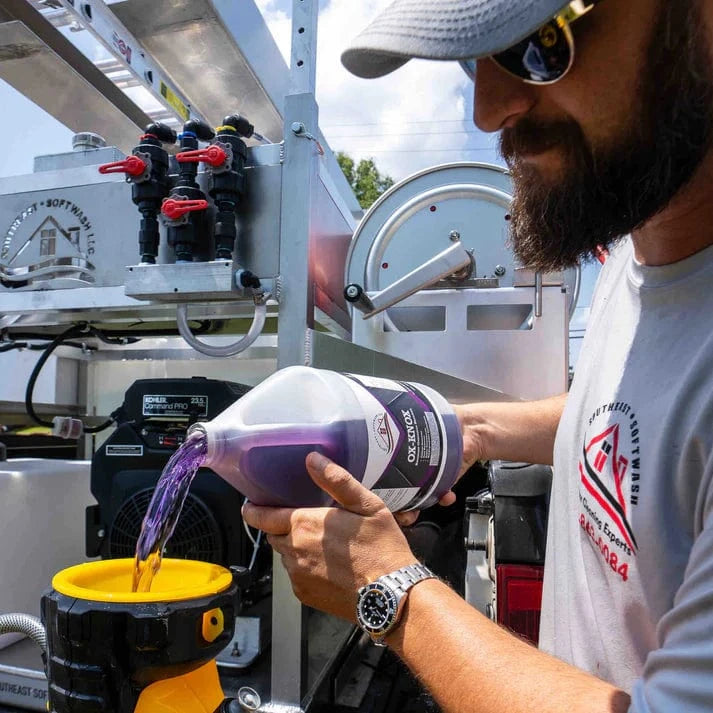
Mix your Gutter Guard concentrate according to the label directions. Because it's a super-concentrated formula, a little goes a long way, and diluting correctly gives you the right strength without wasting product.
Apply the solution to the gutter face, working in manageable sections of around three to four feet at a time. Spray it on evenly so the entire striped area is coated. Start at one end of the house and move steadily along, rather than trying to soak the whole run at once, this keeps the cleaner from drying before you can work it.
Give the cleaner a few minutes of dwell time to penetrate and break down the grime. This is where a quality product earns its keep. The formula gets to work loosening the bonded residue so you don't have to rely on brute force.
Don't let it dry on the surface, though. On a hot, sunny day, work in smaller sections and keep an eye on the cleaner. If it starts to dry, mist it lightly with water to reactivate it.
For light staining, the cleaner may lift the stripes on its own. For anything more stubborn, work the surface gently with your soft-bristle brush. Use light, even strokes following the direction of the stripes.
You're agitating, not scrubbing aggressively. The chemistry does the heavy lifting; the brush just helps release grime that's already been loosened. Heavy scrubbing with a stiff brush or abrasive pad risks scratching or dulling the finish, which creates a rougher surface that attracts dirt even faster next time.
Rinse the section with clean water from top to bottom before moving on. A standard garden hose is plenty. If you use a pressure washer, keep it on a low setting and hold the nozzle well back, high pressure at close range can strip the finish, dent aluminum, or force water behind the gutters.
As you rinse, you should see the streaks disappear and the original color return. Work down the entire run, section by section, until the whole length is clean.
Once everything is rinsed and beginning to dry, step back and look at the gutters from ground level in good light. Any faint remaining shadows can be spot-treated with a second application. Reapply the cleaner to those areas, give it a little more dwell time, agitate, and rinse again.
Some gutters, especially those that haven't been cleaned in years, have deeply set stripes that resist the first pass. Don't assume they're permanent. In most cases they'll come off; they just need a more focused approach.
For these tougher jobs, use the cleaner at the stronger end of the recommended dilution range, extend the dwell time slightly, and be prepared to apply it twice. The light brushing step becomes more important here. Gutter Guard is built for exactly this situation, delivering professional-grade cleaning power for heavily soiled areas with light brushing rather than requiring you to replace the gutters or repaint them.
If the stripes genuinely will not shift after repeated treatment, the finish itself may be oxidized to the point where the color has faded rather than just being dirty. In that rare case, the metal isn't stained so much as weathered, and restoration would involve a specialist gutter-brightening treatment or repainting. But this is uncommon. The overwhelming majority of what looks like permanent staining is grime that a proper cleaner will remove.
Cleaning is only half the battle. Keeping gutters looking good means slowing the return of the stripes.
Clean on a regular schedule. The longer grime sits, the more firmly it bonds and the harder it is to remove. A light annual or twice-yearly clean is far easier than tackling years of accumulation. If you live near busy roads, industrial areas, or under heavy tree cover, lean toward twice a year.
Keep the gutters flowing. Overflowing gutters send more dirty water cascading over the front face, which accelerates striping. Clearing debris from the trough and downspouts reduces overflow. Gutter guards or leaf screens can help here, and we've discussed choosing and fitting them in our dedicated guttering guides.
Fix overflow and drip points. If one section of gutter consistently overflows or drips, water repeatedly washes the same channel and re-stains it quickly. Correcting the slope or clearing the blockage solves the root cause.
Address roof runoff. Asphalt shingle roofs shed grit and tannins that stain gutters. There's no eliminating this entirely, but keeping the roof clean of moss and debris reduces the load of material washing into and over your gutters.
A quick rinse-down with your gutter cleaner once a year keeps the finish clean enough that stripes never get a chance to set in hard, turning what could be a heavy annual chore into a fifteen-minute maintenance pass.
Gutter Guard gutter cleaning chemical is designed its gutter cleaning chemicals to be cost-effective and highly efficient for removing black stripes on gutters.
Depending on the soil's severity, Gutter Guard can be a touchless spray-on and rinse or, if necessary, require light agitation with a soft brush.
This Gutter Guard gutter cleaning chemical is super concentrated, which makes it attractive for shipping and cost-efficient. Dilute Gutter Guard two parts water to one part product, or up to three parts water to one part product.
To use, wet down the gutter with the ready-to-use solution, or apply a more concentrated solution using your pressure washer chemical injector, then rinse off with lower pressure. On heavily soiled areas, light brushing with a soft brush may be necessary.
Even a simple job goes wrong when a few key errors creep in. Here are the mistakes that cost people time, money, and results.
Using the wrong cleaner. By far the most common mistake is reaching for dish soap, all-purpose spray, or bleach and expecting tiger stripes to vanish. They won't. These products aren't designed to break the electrostatic bond that holds the streaks in place, so you end up scrubbing endlessly for a mediocre result. A dedicated gutter cleaner solves in minutes what generic products struggle with for an hour.
Scrubbing too hard with the wrong tool. Attacking stripes with a stiff wire brush, abrasive pad, or scouring sponge feels productive, but it scratches and dulls the aluminum finish. That microscopic roughness then grabs dirt faster, so your gutters restripe more quickly than before. Always use a soft-bristle brush and let the cleaner do the work.
Using a pressure washer at full power. High-pressure water at close range can dent aluminum, strip the painted finish, and blast water up behind the gutters into the fascia and soffit, causing rot over time. If you use a pressure washer at all, keep it on a low setting and hold it well back.
Letting cleaner dry on the surface. Applying cleaner to the whole house at once, then working slowly, means the first sections dry before you reach them. Dried cleaner can streak and is far harder to rinse cleanly. Work in small, manageable sections.
Skipping the interior clean. Restoring the outer face while the trough is still packed with debris is wasted effort. The next rain overflows and re-stains everything. Always clear the inside first.
Ignoring ladder safety. Rushing the setup, overreaching, or resting a ladder against the gutter itself causes falls and dents. Use a stabilizer or standoff, keep your hips within the ladder's rails, and move the ladder rather than stretching.
Not diluting concentrate correctly. With a super-concentrated product, using it neat wastes it and, on delicate finishes, can be harsher than necessary. Using it too weak means poor results. Follow the label dilution and adjust within the recommended range for heavier staining.
The difference between an amateur clean and a professional finish usually comes down to a handful of small techniques and habits.
The phrase "tiger stripes" gets used in a few very different contexts, and if you searched the term you may have seen results mixing them together. For completeness, here's a quick clarification so you land on the right information.
In hairdressing, "tiger stripes" or "stripey highlights" describe bold, harsh bands of color where highlights are too thick, too few, or too high in contrast against the base color, producing an obvious striped effect rather than a soft, blended one.
To fix tiger stripe highlights at home, the usual approach is to add a toner or a gloss to reduce the contrast, or to add finer, more numerous highlights and lowlights between the existing bands so the color blends. Getting rid of stripey highlights at home often means applying a lowlight close to your natural shade to break up the harsh lines. To avoid tiger stripes when highlighting in the first place, use finer sections, weave rather than slice the strands, and keep highlights closer in tone to your base color. That said, colour correction is genuinely tricky, and a professional stylist will get a smoother, safer result than most DIY attempts, so for anything dramatic it's worth booking a salon.
This is, of course, a completely different subject from cleaning gutters, but it shares the same memorable name.
"Tiger Seal" is also the brand name of a well-known polyurethane adhesive sealant used in automotive and construction work. Yes, it can be removed. While it's still wet or uncured, wipe it away with a suitable solvent or panel wipe. Once cured, it's much tougher: you'll typically need to cut or peel the bulk away carefully with a plastic or blunt scraper to avoid damaging the surface, then treat the residue with a dedicated adhesive remover. Heat can soften cured sealant to make peeling easier.
Again, that's a separate topic from gutter cleaning, but worth noting so you're not left wondering.
With those cleared up, let's return to the main event, getting your gutters looking their best.
Word-of-mouth is marketing gold. Encourage your happy customers to spread the word with a referral program.
Make it easy and rewarding for customers to refer you. Offer a discount, a free service, or a gift card for every new customer they bring in.
Tell everyone about your referral program. Put it on your website, share it on social media, and mention it in your emails.
Make sure your customers know how it works and what they’ll get.
Throughout this guide, one theme keeps surfacing: tiger stripes aren't ordinary dirt. They're grime chemically and electrostatically bonded to a slightly oxidized aluminum finish, which is exactly why plain water, dish soap, and household cleaners disappoint so many homeowners. You can scrub for an hour with the wrong product and barely make a dent, then risk damaging the finish in frustration.
That's the specific problem Gutter Guard is built to solve. It's a super-concentrated gutter cleaner formulated to break down the stubborn black streaks, tiger stripes, and grime that accumulate on aluminum gutters. Rather than relying on abrasion and effort, it dissolves the bond holding the stripes in place, so they release and rinse away cleanly. The application is straightforward: spray it on, let it dwell, rinse it off, with only light brushing needed on heavily soiled areas.
A few advantages make it the sensible choice over the alternatives:
Who should use it? Any homeowner with aluminum gutters showing dark vertical streaks, chalky discoloration, or general grime, and anyone who wants to keep restored gutters looking clean with an easy annual maintenance pass.
Who might not need it? If your gutters are brand new and spotless, you don't need it yet, though a light seasonal clean will keep them that way. And in the rare case where the finish itself is severely oxidized and faded rather than dirty, no cleaner will restore lost color; that situation calls for gutter brightening or repainting instead. For the vast majority of striped, grimy gutters, though, a dedicated cleaner is exactly what the job needs.
To get the most from it, dilute according to the label, work in shaded conditions and small sections, give it proper dwell time, agitate lightly only where needed, and rinse top-down. Follow that process and you'll see the stripes lift on the first or second pass.
Tiger stripes on gutters look permanent, but they almost never are. They're bonded grime, not damaged metal, and they won't wash away on their own no matter how much it rains. Removing them comes down to the right method and the right cleaner.
The winning approach is simple: clear the inside of the gutters first, pre-wet the surrounding surfaces, apply a dedicated gutter cleaner in manageable sections, give it time to dwell, agitate gently with a soft brush where needed, and rinse thoroughly from top to bottom. Work in the shade, protect your plants, and stay safe on the ladder. For stubborn, years-old staining, a stronger dilution and a second application will handle almost anything.
Just as important, don't stop at a one-off rescue clean. A quick annual maintenance pass keeps the finish clean enough that stripes never set in hard, turning a heavy job into a fifteen-minute task.
Because tiger stripes are a bonded, electrostatic stain rather than loose dirt, a purpose-built product makes all the difference. Gutter Guard's super-concentrated formula is designed precisely for this, dissolving black streaks and grime with an easy spray-on, rinse-off application and only light brushing where the soiling is heaviest. Use it correctly, keep to a simple maintenance routine, and your gutters will stay clean, uniform, and looking their best year after year.