



How to Choose a Pressure Washing Skid for Large Commercial Projects
|
|
Time to read 16 min
|
|
Time to read 16 min
Landing a large commercial contract—an office park, a fleet of trucks, a multi-building HOA, or an industrial facility—changes everything about your equipment needs. The consumer-grade unit that handled residential driveways will stall out on day one. Large projects demand sustained runtime, serious water capacity, and the ability to switch between high-pressure cleaning and gentle soft washing without dragging gear back and forth to a spigot.
That's where a pressure washing skid comes in. A skid isn't just a bigger pressure washer—it's a complete, truck-mounted cleaning system engineered for professionals who bill by the job and can't afford downtime.
This guide walks you through exactly how to choose the right skid for large commercial work: what "commercial grade" really means, how much PSI and GPM you actually need, how to size your water and chemical tanks, and what separates the setups professionals trust from the ones that leave you stranded mid-contract. By the end, you'll be able to spec a system with confidence.
A commercial-grade pressure washer is a machine built for continuous, heavy-duty use—think hours of runtime per day, several days a week, for years. It differs from a homeowner unit in nearly every component: a triplex or industrial pump instead of an axial-cam pump, a commercial engine (often Honda, Kohler, or Vanguard), higher flow rates, and a frame designed to survive constant transport and vibration.
A pressure washing skid takes that commercial machine and integrates it into a self-contained platform that mounts directly onto your truck bed or trailer. Instead of relying on a customer's water source, you carry your own supply. A typical skid includes:
A large fresh-water buffer tank (so your pump never runs dry)
One or more chemical tanks for bleach (sodium hypochlorite) and soap or surfactant
A commercial engine and pump combination
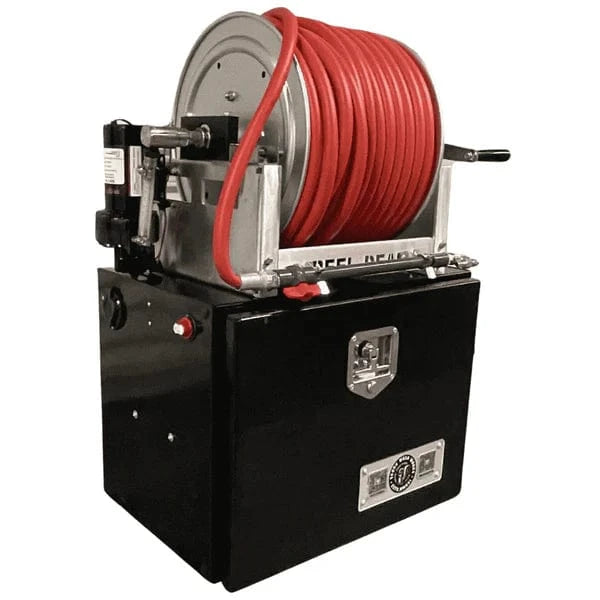
Hose reels, plumbing, and a proportioning or metering system for soft washing
A rigid frame sized to bolt securely into a truck bed
The skid format matters for large jobs because it eliminates two of the biggest bottlenecks in professional cleaning: water access and chemical management. When you pull up to a 40,000-square-foot warehouse or a stretch of commercial sidewalk with no convenient water hookup, a self-contained system with hundreds of gallons of onboard water keeps you working.
A standalone pressure washer is just the engine and pump. You still have to source water, mix chemicals in buckets, and haul everything into position. For a residential side hustle, that's workable. For large commercial projects, it's a recipe for wasted hours and inconsistent results.
A skid consolidates the entire operation. You mix and store chemicals once, connect your water buffer, and run continuously. The difference on a big job is measured in hours saved per day—and on a multi-day contract, that translates directly into profit.
The other major advantage is soft washing capability. Many commercial surfaces—stucco, painted panels, roofs, wood, and delicate signage—can't tolerate high pressure. Soft washing uses low pressure combined with a bleach-and-soap solution to kill organic growth and clean safely. A true commercial skid handles both pressure washing and soft washing from the same platform, which is exactly why chemical capacity is as important as pump power.
Choosing a skid comes down to matching capacity and power to the scale of your work. Undersize it and you'll spend your day refilling tanks and waiting on the pump to cool. Oversize it for tiny jobs and you've spent money you didn't need to. For large commercial projects, though, the risk is almost always undersizing.
Here are the factors that matter most, in order of importance.
Water capacity is the single most limiting factor on large jobs. Your pump consumes water at its rated GPM continuously—so a 5.5 GPM machine running for an hour needs roughly 330 gallons if there's no refill source.
On commercial sites, you can't count on a reliable spigot, and even when one exists, low municipal pressure can starve your pump. A generous onboard buffer tank lets you work independently and refill on your own schedule. For large-scale work, look for systems with substantial fresh-water capacity—enough to run for extended stretches before topping off.
The buffer tank also protects your pump. Feeding a high-flow pump directly from a garden hose often can't keep up, causing cavitation that destroys pump seals over time. Drawing from a large onboard tank guarantees the pump always has the volume it needs.
If you plan to take on commercial soft washing—and on large projects, you almost certainly should—chemical capacity determines how much surface you can treat before mixing more.
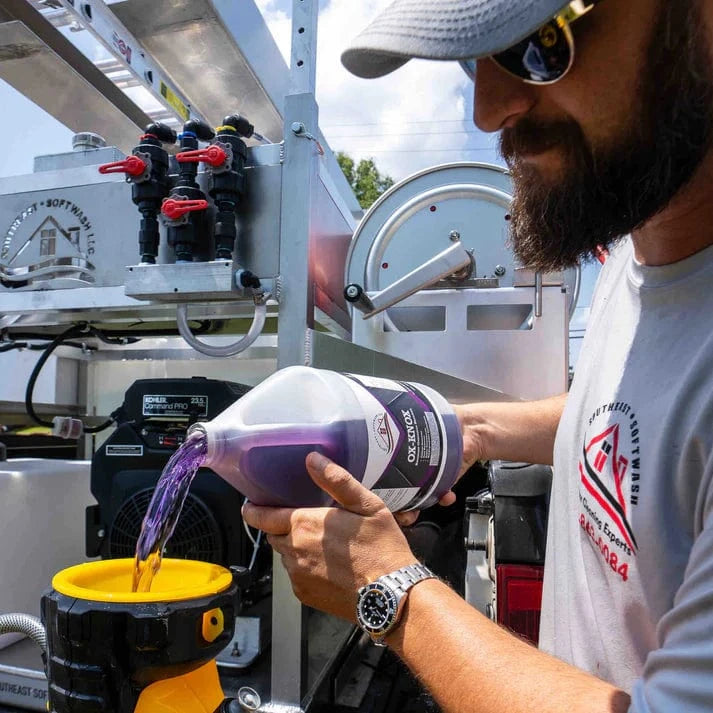
Soft washing consumes sodium hypochlorite (bleach) and surfactant in volume. A roof cleaning job or a large building exterior can burn through dozens of gallons of mixed solution. A skid with dedicated, high-capacity bleach and soap tanks lets you pre-mix enough to finish the job in one pass.
This is precisely where a purpose-built system earns its keep. The PolyMAX™, for example, was designed around massive water, bleach, and soap capacity specifically so crews can tackle the toughest, largest cleaning jobs without constant resupply. On big contracts, that reserve capacity is the difference between finishing in a day and stretching a job across two.
Because bleach is highly corrosive, the tank and plumbing material matters enormously here—which leads directly to the next consideration.
Sodium hypochlorite eats through the wrong materials. Cheap tanks crack, fittings corrode, and metal frames rust when exposed to bleach spray and constant moisture. A skid built for professional soft washing has to resist chemical attack for years, not months.
Copolymer tanks are the professional standard because they stand up to bleach without degrading. The PolyMAX™ system takes its name from its copolymer construction for exactly this reason—it's engineered to survive the corrosive reality of daily soft washing while maintaining structural integrity under the weight of hundreds of gallons of liquid bouncing down the highway.
When evaluating any skid, ask what the tanks are made of, how the plumbing is rated for chemical exposure, and how the frame handles both weight and corrosion. Durability here isn't a luxury—it directly affects your total cost of ownership.
A skid is only useful if it fits your vehicle and stays put in transit. Weight is the critical variable: water weighs about 8.3 pounds per gallon, so a fully loaded large-capacity system can add well over a thousand pounds. You need a truck rated to carry that payload safely.
Most professional skids are designed to fit full-size trucks, which offer the bed dimensions and payload capacity these systems require. The PolyMAX™ system, for instance, is built to fit most full-size trucks—a practical design choice, since that's the class of vehicle serious commercial operators already run.
Before buying, confirm your truck's payload rating, verify the skid's loaded weight, and plan for secure mounting so the system doesn't shift when you brake or corner. Never load a skid onto a vehicle that isn't rated for the weight—it's both a safety hazard and a fast way to destroy your suspension.
This is where a lot of buyers get the priorities backward. Most people fixate on PSI, but for professional cleaning, GPM (gallons per minute) matters just as much or more.
PSI (pounds per square inch) measures the force of the water stream—its ability to blast contaminants loose. Commercial pressure washers typically range from about 3,000 to 4,000+ PSI, compared to 1,500–2,000 PSI on consumer units.
For most professional surface cleaning, the best PSI sits in the 3,000 to 3,500 range. That's enough to strip dirt, gum, and grime from concrete, brick, and hard surfaces without the extreme force that can gouge softer materials. Higher PSI—into the 4,000 range—is useful for industrial degreasing, paint prep, and heavy buildup, but it also increases the risk of surface damage if used carelessly.
Here's the key point most people miss: past a certain threshold, adding PSI delivers diminishing returns. A 3,500 PSI machine and a 4,200 PSI machine will clean the same driveway at roughly the same visual result—but the higher-PSI unit won't clean it meaningfully faster. Speed comes from flow.
GPM determines how quickly you rinse contaminants away and how much surface you cover per minute. Two machines at the same PSI but different flow rates will finish a job at dramatically different speeds—the higher-GPM unit wins every time.
Consumer washers push 1.5–2 GPM. Professional commercial machines run 4 to 8 GPM, and high-output systems go higher still. On large commercial projects, flow is what makes the job economically viable. A crew running 5.5–8 GPM will clean a parking lot in a fraction of the time a homeowner-grade 2 GPM unit could manage—if the small unit could finish at all before overheating.
So when someone asks which pressure washer is "the most powerful," the honest answer is that true cleaning power is a combination of PSI and GPM. The industry even has a metric for it: cleaning units (CU), calculated as PSI × GPM. A machine at 3,500 PSI and 5.5 GPM delivers 19,250 cleaning units—far more real-world power than a 4,000 PSI unit at 3 GPM (12,000 CU), despite the lower headline pressure number.
For large commercial work, prioritize high GPM with solid mid-range PSI. That combination cleans fast without damaging surfaces.
"Size" for commercial buyers really means two things: machine output (PSI and GPM, covered above) and system capacity (tank volume). Match both to the scale of your typical job.
For large commercial projects—big flatwork, multi-building exteriors, fleet washing, and industrial sites—you want:
A pump and engine delivering roughly 4,000 PSI and 5.5+ GPM, or the highest flow your workflow can support
Large water buffer capacity so you can run continuously without hunting for a spigot
High chemical capacity for bleach and soap if soft washing is part of the scope
A frame and vehicle setup that keeps everything mobile and secure
Smaller residential-focused operators can get by with a compact 4 GPM cart or a modest skid. But if you're bidding contracts measured in tens of thousands of square feet, undersizing your system will cost you far more in lost time than you'll ever save on the purchase price.
A well-specced large-capacity skid like the PolyMAX™ is aimed squarely at this tier of work—operators who need to arrive, set up once, and clean at scale without interruption. If your projects are consistently big, size up. The capacity pays for itself in throughput.
Poly MAX Dimensions: LENGTH 81" / Width 44" at base of unit with overall shelf width of 78" / Height-60" at the ladder rack. Dry weight-1250 lbs. 100 gal water capacity 100 gal bleach capacity 10gal soap tank. This is the Mack Daddy of the SESW lineup. Designed to fit most full size trucks, the PolyMAX has all the firepower you need to tackle any job.
There's a persistent myth that the "best" pressure washer is a specific consumer brand you can grab off a big-box store shelf. In reality, established commercial operators rarely use those units for serious work. Here's what the professionals running large accounts actually rely on.
Professionals use integrated skid or trailer systems, not standalone pressure washers. The machine itself—engine and pump—is only one part of the setup. The pros build around water tanks, chemical tanks, soft wash proportioners, reels, and a mounting platform, because that's what makes large-scale work profitable.
When you see a top crew arrive at a commercial site, they roll up with a truck-mounted or trailer-mounted skid, run a couple of hose reels, and switch between pressure washing and soft washing on demand. That workflow is impossible with a bare machine.
Rather than obsessing over the brand name on the frame, experienced buyers look at the components inside:
Pumps: Industrial triplex pumps (brands like General Pump, Udor, and Comet are widely trusted) are the professional standard. They tolerate continuous duty and rebuild easily.
Engines: Honda GX-series, Kohler Command, and Vanguard engines dominate professional setups for their reliability and parts availability.
Tanks and construction: Copolymer tanks and chemical-resistant plumbing for anyone doing soft washing.
So if you're wondering which brand makes the best high-pressure washer, the better question is which system pairs proven components into a durable, high-capacity platform. The "best pressure washer for commercial use" isn't a single SKU—it's the complete system that matches your workload.
Instead of a top-5 list of consumer models that won't survive a commercial season, here's how professionals rank their real options, from lightest to heaviest duty:
Compact commercial cart (3,000–3,500 PSI, 4 GPM) — light commercial and residential
Mid-size skid (3,500–4,000 PSI, 4–5.5 GPM, moderate tanks) — steady commercial work
Large-capacity soft wash skid (4,000 PSI, 5.5+ GPM, high water and chemical capacity) — large commercial and soft wash contracts
Dual-system or trailer rig (multiple pumps, very high capacity) — enterprise and industrial accounts
Custom hot-water trailer systems — specialized degreasing and food-industry work
For most operators taking on large commercial projects, the sweet spot is that third tier: a large-capacity soft wash skid that fits a full-size truck. It offers enterprise-level capacity without the bulk and expense of a full trailer rig. That's exactly the category the PolyMAX™ system occupies.
Even experienced operators make expensive errors when choosing and running a commercial skid. Here are the ones that cost the most time, money, and equipment.
Chasing PSI while ignoring GPM. The most common beginner mistake is buying the highest-PSI machine available and assuming it's the most powerful. As we covered, GPM drives cleaning speed. Buy for flow first, then adequate pressure. A high-PSI, low-flow unit will make you slow and unprofitable on large jobs.
Undersizing water capacity. Operators frequently buy a skid with a strong pump but a small tank, then discover their pump drains the tank in twenty minutes. On a commercial site with no water access, that stops the job cold. Always match tank capacity to your pump's flow rate and your typical runtime.
Using the wrong materials for bleach. Running sodium hypochlorite through equipment not rated for it destroys pumps, tanks, and fittings—sometimes within weeks. If you plan to soft wash, insist on copolymer tanks and chemical-resistant plumbing from the start. Retrofitting later costs more than buying right the first time.
Overloading the vehicle. Loading a fully filled skid onto an undersized truck is dangerous and damaging. Water is heavy. Calculate loaded weight, confirm your truck's payload rating, and don't exceed it. This is a safety issue, not just a mechanical one—overloaded vehicles handle poorly and brake badly.
Skipping the pump-protection buffer. Feeding a high-flow pump directly from a garden hose starves it and causes cavitation, which shreds seals over time. Always run the pump from a buffer tank so it has consistent volume. This single habit can double the life of your pump.
Using too much pressure on delicate surfaces. Blasting stucco, painted panels, wood, or roofs with 3,500+ PSI causes visible damage and unhappy clients. Learn which surfaces require soft washing and switch to low-pressure chemical cleaning for them. A pressure gouge on a commercial building is an expensive callback.
Letting bleach sit in the system. Failing to flush your lines and pump after soft washing leaves corrosive chemical to sit and degrade components. Flush with clean water at the end of every job. It takes minutes and saves hundreds in repairs.
Once you've got the right equipment, technique and workflow separate the crews that finish fast and clean well from the ones that struggle. Here's what experienced professionals do differently.
Pre-treat, then let dwell time do the work. On organic staining—algae, mold, mildew—apply your bleach-and-soap solution and let it dwell before rinsing. The chemistry kills the growth; you don't need to blast it off with brute force. This protects surfaces and cuts your labor dramatically. On many soft wash jobs, dwell time replaces pressure entirely.
Match your nozzle to the task. Nozzle selection changes everything. A wider fan (25° or 40°) covers ground fast for general cleaning, while a narrower tip concentrates force for stubborn spots. Keep a full nozzle set and change frequently. Surface cleaners—rotating attachments that clean flatwork in even passes—dramatically speed up large concrete jobs and leave no streaking.
Work top to bottom on verticals, and section your flatwork. On building exteriors, clean from the top down so runoff doesn't re-dirty finished areas. On large flatwork, mentally divide the area into manageable sections and complete each fully before moving on. Systematic coverage prevents the streaking and missed spots that force rework.
Batch your chemical mixing. With high-capacity tanks, mix enough solution for the whole job before you start. Stopping mid-project to re-mix bleach kills your rhythm and your margins. This is exactly why large chemical capacity matters—it lets you set your mix once and run.
Manage your water strategy. Before you leave the shop, know where you'll refill on long jobs. A large onboard buffer buys you runtime, but on multi-hour projects you'll still want a plan. Scout for hydrants (with permits where required), on-site spigots, or a refill route so you're never caught empty.
Protect the surroundings. Bleach runoff can kill landscaping and stain surfaces. Pre-wet plants, rinse them after, and control runoff. Professional-grade results include leaving the site—and the client's property—undamaged. This attention to detail wins repeat contracts.
Maintain religiously. Check pump oil, inspect hoses for wear, flush chemical lines after every job, and winterize when temperatures drop. A skid is a serious investment, and downtime on a booked week is far more expensive than routine maintenance. Build a quick end-of-day checklist and stick to it.
Track your cleaning units and job times. As you gain experience, record how long different job types take with your setup. This data lets you bid accurately and prove to yourself whether higher capacity or flow would improve your margins. The best operators treat their equipment as a profit calculation, not just a tool.
Across this guide, the same themes surfaced again and again: large commercial projects demand high flow, generous water capacity, serious chemical volume for soft washing, chemical-resistant construction, and a platform that mounts securely to the truck you already drive. Miss any one of those, and you're either stuck refilling tanks, damaging equipment with corrosive chemicals, or turning down jobs you could have won.
The PolyMAX™ was built to answer all of those requirements in a single platform. As the flagship of the SESW lineup, it's engineered around massive water, bleach, and soap capacity—the exact reserve that lets crews finish large jobs in one pass instead of stopping to resupply. That capacity directly solves the biggest bottleneck we identified for large-scale work: running out of water or chemical before the job is done.
Its copolymer construction addresses the durability problem head-on. Sodium hypochlorite destroys the wrong materials, and the corrosion-resistant copolymer tanks are designed to withstand years of daily soft washing without degrading. That's a meaningful advantage over budget systems that use cheaper tanks and fail within a season or two of heavy chemical use.
The system also handles both pressure washing and soft washing from one setup, so you can strip a concrete lot and then gently clean a stucco facade or a delicate sign without swapping equipment. For commercial operators whose contracts include a mix of surfaces, that versatility is essential rather than optional.
Because it's designed to fit most full-size trucks, it slots into the vehicle class serious operators already run—no specialty trailer required, and no compromise on the payload and capacity large jobs demand.
Who should use it: Professional cleaning businesses taking on large commercial projects—warehouses, office parks, HOAs, fleet washing, multi-building exteriors, and high-volume soft wash contracts. If your work is consistently big and you can't afford downtime or corrosion failures, this is the tier of system that pays for itself in throughput.
Who may not need it: If you're a residential-only operator cleaning the occasional driveway or a weekend side-hustler, a large-capacity flagship skid is more system than your work requires. A compact commercial cart would serve you better and cost less. The PolyMAX™ is purpose-built for high-volume commercial and soft wash work—buy it when your project scale actually justifies the capacity.
How to use it effectively: Load your bleach and soap mix once at full capacity so you can run a large job uninterrupted. Feed the pump from the onboard buffer to protect it from cavitation. Use dwell time and appropriate nozzles rather than maximum pressure on delicate surfaces. And flush the chemical lines with clean water after every job to preserve the system for the long haul.
Choosing a pressure washing skid for large commercial projects isn't about finding the single highest PSI number or the most recognizable brand. It's about matching a complete system to the scale of your work—prioritizing flow (GPM) over raw pressure, sizing your water and chemical tanks to your runtime, insisting on chemical-resistant construction, and mounting it all safely on a truck rated to carry the load.
Remember the fundamentals: aim for roughly 3,500–4,000 PSI paired with 5.5+ GPM for serious commercial cleaning, since cleaning speed comes from the combination of pressure and flow. Carry enough water to run without hunting for a spigot, and enough bleach and soap capacity to finish soft wash jobs in a single mix. Protect your pump with a buffer tank, respect delicate surfaces with soft washing, and maintain the system after every job.
For operators whose work is consistently large-scale and involves both pressure washing and soft washing, a high-capacity, copolymer-built system like the PolyMAX™ brings all of these requirements together in one durable, truck-ready platform. Match your equipment to your ambitions, spec it correctly the first time, and you'll spend your days cleaning and billing—not refilling tanks or repairing corroded gear.