



How to Remove Oxidation on Vinyl Siding, Without Brushing
|
|
Time to read 15 min
|
|
Time to read 15 min
If your once-vibrant vinyl siding now looks faded, chalky, and dull—and leaves a white residue on your hand when you wipe it—you're not dealing with ordinary dirt. You're dealing with oxidation. And the frustrating part is that no amount of regular washing seems to bring the color back.
The good news? You can remove oxidation from vinyl siding completely without scrubbing, ladders full of elbow grease, or risking damage to the panels. The secret lies in understanding what oxidation actually is and using a product chemistry that dissolves it rather than abrading it away.
This guide walks you through exactly how to do that. We'll cover what causes the chalky film, why brushing is often the wrong approach, which popular home remedies are worth your time (and which waste it), and the step-by-step no-scrub method professionals rely on.
Oxidation is a chemical reaction between the surface of your siding and oxygen, accelerated by prolonged UV exposure. Over years of sunlight, the polymers and pigments at the surface of the vinyl break down, leaving behind a thin, powdery layer of degraded material. That's the chalky white film you see and feel.
It's worth understanding that oxidation isn't sitting on top of your siding the way mud or pollen does. It's the deteriorated outer layer of the siding itself. This is precisely why ordinary soap and water don't fix it—you're not washing away a contaminant, you're trying to lift away a bonded, broken-down surface layer.
So what kills oxidation? The reaction itself can't be reversed, but the chalky residue it leaves behind can be dissolved and lifted. That requires a cleaner with the right chemical action—something that breaks the bond holding the oxidized particles to the surface so they rinse away cleanly. Mild acids, certain surfactants, and purpose-built oxidation removers all work through this dissolving action rather than physical abrasion.
This distinction matters more than almost anything else in this guide. The methods that actually work attack oxidation chemically. The methods that fail rely on grinding it off, which damages the siding and rarely restores the finish evenly.
Before you choose a treatment, confirm what you're actually looking at, because the wrong diagnosis leads to the wrong product.
Oxidation appears as a uniform, chalky, faded film—often most visible on the sun-facing walls (south and west exposures). Run a clean, dry finger across it; if you pick up a white, powdery residue, that's oxidation.
Mildew and mold show up as black, green, or dark gray spots and streaks, usually concentrated in shaded, damp areas like north-facing walls or sections behind shrubs.
General dirt and pollen wash off easily with water and mild detergent and don't leave a chalky residue.
You can have all three at once, which is common on siding that hasn't been cleaned in several years. A quality oxidation remover will often handle dirt and biological growth in the same pass, but knowing your primary problem helps you set expectations.
Here's the principle that makes no-scrub removal possible: if the cleaning solution does the chemical work, your hands don't have to do the mechanical work. When you apply a product that dissolves the oxidized layer, all that's left is to rinse it away.
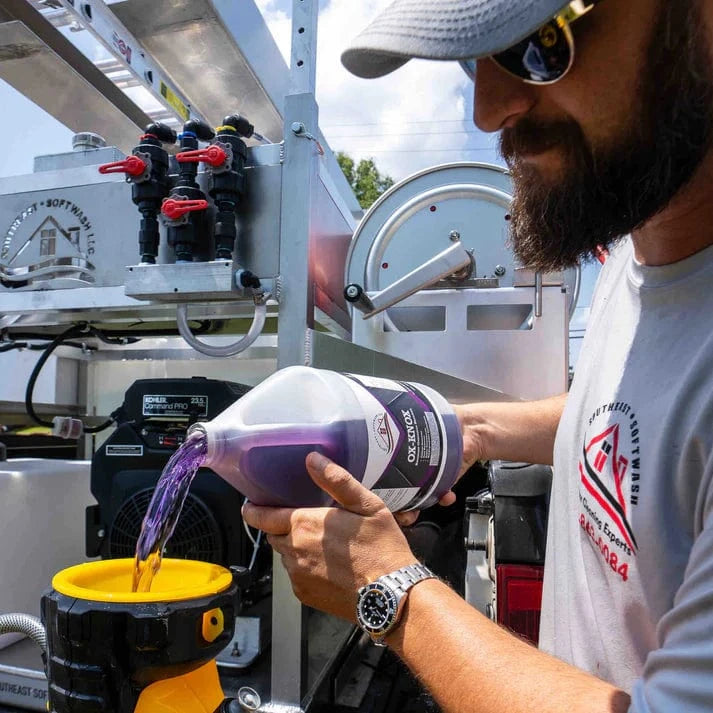
This is where a dedicated oxidation remover like Ox Knox earns its place. It's formulated specifically to break down the oxidized film on vinyl, AlucoBond, Hardie Board fiber cement, and metal roofing, then release it from the surface so a simple rinse carries it off. Because the product loosens the bond chemically, you skip the scrubbing entirely.
Follow these steps for a clean, even result without abrasion:
A note on pressure washing: it can speed up rinsing, but it isn't doing the oxidation removal—the chemistry is. Keep the pressure moderate and the nozzle at a distance, and never aim upward where water can get behind the panels. If you want a deeper breakdown of safe pressure settings, we've covered pressure-washing techniques for siding in detail elsewhere.
Mildew responds to the same no-scrub philosophy: kill and dissolve it chemically, then rinse, rather than agitating it loose with a brush.
The mistake people make is reaching for a stiff brush and scrubbing the spots, which can spread spores and burnish the siding unevenly. Instead, apply a cleaning solution that targets the biological growth, let it dwell long enough to break it down, and rinse.
For light mildew, a solution of oxygen bleach (sodium percarbonate) and water is gentle and effective—and unlike chlorine bleach, it won't harm plants or strip color. Apply it, let it sit for ten to fifteen minutes, and rinse.
For siding that has both mildew and oxidation, a dedicated remover that addresses both saves you a step. Because Ox Knox is built to lift oxidation and is also effective against soot and fallout, it handles the grimy, multi-problem walls that plague older homes without requiring you to switch products mid-job.
The key for any no-scrub mildew removal is dwell time. Give the solution the minutes it needs to do the chemical work, and you replace muscle with chemistry.
This is where most people start, usually after a search for the cheapest possible fix. Some pantry remedies have a kernel of truth to them; others are internet myths that waste an afternoon. Let's go through the popular ones honestly.
The short version: mild acids found in your kitchen can nibble at light oxidation on small surfaces, but they're inconsistent, slow, and impractical for an entire house. Here's how each stacks up.
Vinegar comes up constantly, so let's answer both halves of the question.
Can vinegar remove oxidation? To a limited degree, yes. White vinegar is a mild acid (acetic acid), and on light oxidation it can loosen some of the chalky residue. A common DIY mix is roughly 30% white vinegar to 70% water with a squirt of dish soap. On a small, lightly oxidized area, you might see modest improvement after letting it dwell and rinse.
But vinegar has real limits. It's weak, it works slowly, and on moderate-to-heavy oxidation it barely makes a dent. You'll often find yourself scrubbing to compensate for the weak chemistry—which defeats the entire no-brush goal.
Will vinegar ruin vinyl siding? Standard household white vinegar, properly diluted, won't ruin vinyl siding. Vinyl is fairly chemical-resistant, and diluted acetic acid is mild. The bigger risks come from misuse: using undiluted industrial-strength vinegar, letting it dry on the surface in hot sun (which can cause streaking), or letting runoff pool on plants and landscaping below, which acid can damage. So vinegar is safe enough in dilution, but "safe" and "effective" aren't the same thing. For a full house, it rarely delivers.
Baking soda is a mild abrasive and a base, so it works differently than the acids. Made into a paste, it can mechanically buff away light oxidation on a small spot—think a single panel or a test patch.
The problem is twofold. First, it relies on abrasion, which is exactly what you're trying to avoid, and it can leave a dull or unevenly polished patch. Second, it's wildly impractical at scale—nobody is making and rubbing baking soda paste across 2,000 square feet of siding. It's a spot remedy at best, not a whole-house solution.
Lemon juice contains citric acid, which, like vinegar, is a mild acid that can loosen light oxidation. Citric acid is actually a respected ingredient in many commercial cleaners because it's effective and biodegradable.
In its raw, from-the-fruit form, though, lemon juice is too weak and too inconsistent for siding. You'd need an impractical quantity, and the sugars in juice can leave a sticky residue that attracts dirt. The acid concept is sound; squeezing lemons onto your house is not.
This one circulates a lot, usually tied to cleaning car battery terminals or rusty bolts. Coca-Cola contains phosphoric and carbonic acid, which can dissolve light corrosion and oxidation on small metal parts.
On vinyl siding, forget it. The acid concentration is low, the sugar content is high, and you'd be coating your wall in a sticky film that draws bugs and dirt. It might shine up a corroded coin in a bowl; it has no place on the side of your house.
If you insist on a DIY route, the most effective homemade oxidation remover is a blend of a mild acid and a surfactant: white vinegar, water, and dish soap, applied and allowed to dwell. It outperforms baking soda paste for whole-wall use because it doesn't require abrasion, and it's safer for landscaping than chlorine bleach.
People also ask for the "best homemade cleaner for everything," and the honest answer is that the closest thing is a simple all-purpose mix: warm water, a few tablespoons of dish soap, and a splash of white vinegar handles a huge range of household grime. For tougher jobs, oxygen bleach dissolved in warm water is the most versatile workhorse.
But here's the reality check that applies to all of these: homemade cleaners are jacks-of-all-trades and masters of none. They're fine for light, occasional grime. For genuine oxidation—the chalky, bonded, sun-baked layer that's the entire reason you're reading this—they're underpowered. You'll spend more time, get patchy results, and almost always end up reaching for a brush. A purpose-built remover like Ox Knox exists precisely because the kitchen-cabinet approach falls short on the job that matters.
This question applies both to cleaning and to applying treatment afterward, and the best answer is usually: do both, in sequence.
Spraying is fast and efficient. A pump sprayer or low-pressure sprayer lets you cover a large fence quickly and reach into the gaps between pickets. It's ideal for the application stage — getting cleaner (or later, stain) onto the wood evenly and quickly.
Brushing is what actually works the product into the wood. Spraying alone tends to sit on the surface; a brush agitates the cleaner into the grain to lift embedded dirt, and it works to stain into the pores for better penetration and adhesion.
For cleaning, the most effective method is to spray the cleaner on, let it dwell, then agitate with a brush before rinsing. The spray gives you coverage; the brush gives you results.
For applying stain or sealer, the professional approach is often "spray and back-brush" — spray it on for speed, then immediately brush it in to eliminate drips, fill the grain, and ensure even color. If you only do one, brushing gives a more durable, even finish, but it's slower.
So it's not really spray versus brush. Spray for speed and coverage, brush for penetration and quality. Together they beat either method alone.
Ox Knox is specifically designed for the purpose of effectively eliminating oxidation on various surfaces, including Vinyl, AlucoBond, Hardie Board Fiber Cement Siding and Metal Roofing as well as effectively removing soot and fallout. With Ox-Knox in your arsenal, prepare to obliterate oxidation like a true champion.
To ensure optimal results, comprehensive directions are clearly provided on the jug itself. Moreover, you have the flexibility to adjust the potency of the solution based on your specific requirements.
Even with the right product, a few avoidable errors can ruin your results or damage your siding. Here are the ones I see most often.
The difference between a frustrating weekend and a professional-looking result usually comes down to technique, not effort. Here's what the pros do differently.
Word-of-mouth is marketing gold. Encourage your happy customers to spread the word with a referral program.
Make it easy and rewarding for customers to refer you. Offer a discount, a free service, or a gift card for every new customer they bring in.
Tell everyone about your referral program. Put it on your website, share it on social media, and mention it in your emails.
Make sure your customers know how it works and what they’ll get.
Throughout this guide, the same theme keeps surfacing: oxidation is a bonded, degraded surface layer, and the only way to remove it without damaging your siding is to dissolve it chemically rather than grind it off. Homemade acids are too weak and inconsistent, abrasive methods like baking soda burnish the finish, and scrubbing creates streaks while wearing you out. The job calls for chemistry built for the task.
That's exactly what Ox Knox delivers. It's formulated specifically to eliminate oxidation, then release it so a simple rinse carries it away—no brushing required. That single capability solves the central problem this entire article addresses: how to restore your siding's color without abrasion or damage.
Its versatility is the second major advantage. Ox Knox works across vinyl, AlucoBond, Hardie Board fiber cement siding, and metal roofing, and it's also effective at removing soot and fallout. On a typical home that mixes several materials, that means one product for the whole exterior instead of a cabinet full of single-purpose cleaners. It handles the multi-problem walls—oxidation plus grime plus environmental fallout—that defeat pantry remedies.
Compared to the common alternatives, the contrast is clear. Generic all-purpose cleaners and vinegar-based mixes are underpowered for real oxidation and force you back to scrubbing. Abrasive pastes risk uneven, dull patches. Chlorine-heavy products threaten your landscaping and can be harsh to work with. A purpose-built oxidation remover sidesteps all of that by targeting the actual problem with the right chemical action.
Who should use it? Anyone facing genuine oxidation—the chalky, faded film that wipes off white on your hand—especially homeowners with larger walls, mixed siding materials, or buildup that has accumulated over several years. If you've tried washing and the dullness won't budge, you've confirmed you're past what soap can fix.
Who may not need it? If your siding is only lightly dirty with pollen and dust and shows no chalky residue, a basic soap-and-water wash will do the job, and you can save a dedicated remover for when true oxidation sets in. Likewise, if you only have a small, isolated mildew spot, a simple oxygen-bleach solution may be all you need.
To use it effectively: work on cool, shaded siding; pre-rinse; apply even coverage with a pump sprayer; let it dwell without drying; rinse top to bottom; and re-treat heavily oxidized areas as needed. Follow the no-scrub process outlined above and let the product do the work your hands used to.
Removing oxidation from vinyl siding without brushing comes down to one core idea: dissolve the problem instead of scrubbing it. Oxidation is a degraded surface layer, not loose dirt, so the methods that work attack it chemically and rinse it away—while the methods that fail rely on abrasion that damages the finish and exhausts you in the process.
Diagnose what you're actually dealing with first, since oxidation, mildew, and ordinary dirt each call for a different response. Skip the internet myths—Coca-Cola and lemon juice belong nowhere near your house, baking soda is a tiny-spot abrasive at best, and while diluted vinegar won't ruin your siding, it's too weak to handle real oxidation across a full wall. Whatever you apply, work in the shade, give it dwell time, never let it dry on the surface, and rinse properly from the top down.
For the chalky, sun-baked oxidation that drives most people to search for a solution in the first place, a purpose-built remover is the genuine answer. Ox Knox is engineered to break down oxidation on vinyl and a range of other exterior surfaces and let you rinse it clean—no brushing, no burnishing, no guesswork. Match your method to the problem, trust the chemistry over muscle, and your siding's color comes back without the damage that comes from doing it the hard way.