



How to Stop Rust on Your Pressure Washing Skid
|
|
Time to read 16 min
|
|
Time to read 16 min
Rust is the slow, quiet killer of pressure washing equipment. It doesn't announce itself. It starts as a faint orange bloom on a bolt head or a weld seam, then it spreads across your frame, eats through your fasteners, and eventually turns a valuable working skid into a corroded liability.
If you run a pressure washing or soft washing business, your skid lives in a hostile environment. Water, humidity, road salt, and harsh cleaning chemicals like sodium hypochlorite all accelerate corrosion. The good news is that rust is both treatable and, more importantly, preventable. This guide walks you through exactly how to remove existing rust, how to stop it from coming back, and how to choose equipment that never gives rust a foothold in the first place.
Let's start with why your skid rusts at all, because understanding the mechanism is the key to defeating it.
Rust is iron oxide. It forms when iron or steel is exposed to oxygen and moisture over time. That chemical reaction is unavoidable for bare ferrous metal, and a pressure washing rig gives it every possible advantage.
Think about the conditions a working skid endures. It's constantly splashed with water. It carries chemical tanks filled with bleach-based soft wash solutions that give off corrosive fumes. It bounces down the road behind a truck, chipping paint and exposing bare metal at every scratch. And it often sits in an enclosed trailer or garage where humidity lingers.
Sodium hypochlorite, the active ingredient in most soft wash mixes, is especially brutal. Its vapor corrodes steel frames, aluminum components, and electrical connections even when the liquid never directly touches them. Many operators are shocked at how fast a steel skid degrades once they start running high-strength SH batches.
Understanding this helps clarify a hard truth: if your skid is built from untreated or lightly coated steel, rust isn't a possibility, it's a countdown. Your job is either to slow that countdown dramatically or to eliminate the vulnerable material altogether. We'll cover both approaches below.
This is one of the most common questions operators ask, and the honest answer is: partially, but not the way most people hope.
A pressure washer can blast away loose surface rust, flaking scale, and the powdery orange residue sitting on top of metal. High pressure combined with the mechanical force of the water stream will strip away the top layer of oxidation and expose the metal underneath. For light surface rust on a durable surface, this can make a real cosmetic difference.
But pressure washing alone does not cure rust. Here's why. Once corrosion has penetrated the metal, the pitting and the chemical reaction continue below the surface. Blasting off the top layer without treating and sealing the exposed metal simply speeds up re-rusting, because you've now stripped away any protective coating and left fresh, bare metal open to oxygen and water.
For serious rust removal, professionals often pair pressure washing with abrasive methods. Sandblasting or media blasting uses pressurized abrasive material to strip rust down to clean metal and is far more effective than water alone on heavy corrosion. But even then, blasting is only step one. Whatever you expose, you must immediately treat and seal, or the problem returns worse than before.
So think of pressure washing as prep, not cure. It's useful for cleaning a surface before you apply a rust remover or converter, but it won't stop the underlying corrosion process on its own.
When you've already got rust and you need it gone, you have three broad categories of solutions: commercial rust removers, chemical rust converters, and home remedies. Each has a place, and the right choice depends on how bad the rust is and what the part is worth.
For heavy rust, commercial chemical removers are the fastest and most reliable option. The strongest products fall into a few chemistry types, and knowing the difference saves you time and money.
For pressure washing equipment, your best choice depends on what you're treating. On the frame and structural components, a phosphoric acid rust converter is usually the smart play. It stops active rust and leaves a paintable surface, so you can neutralize corrosion on a steel skid frame and then seal it in one workflow.
For smaller removable parts like fittings, brackets, and hardware, a chelating soak solution is ideal. Drop the parts in a bucket, let them soak overnight, and they come out clean without damage. This approach avoids the risk of acid attacking threads or precision surfaces.
Avoid using harsh muriatic acid near pumps, seals, and fittings. The fumes and runoff can corrode nearby components and degrade rubber and plastic parts. Match the aggressiveness of the remover to the value and location of what you're treating.
If speed is your priority, strong acids like phosphoric and hydrochloric acid work fastest, sometimes clearing light rust in minutes. Commercial "instant" rust removers rely on these acids for exactly that reason.
But fast isn't always best. The faster and stronger the chemistry, the more it can damage healthy metal and the more careful you have to be with safety. For most operators, a phosphoric acid product hits the sweet spot: fast enough to work in a single session, controlled enough not to ruin the part. Physical methods like a wire wheel on an angle grinder or a flap disc also remove rust extremely fast on flat, accessible surfaces, and they pair well with a chemical follow-up.
Yes, vinegar genuinely works, and it's one of the most reliable household options. White vinegar contains acetic acid, which dissolves rust through a slow acid reaction. For small parts, submerge them completely in white vinegar and let them soak for several hours to a full day. Then scrub with a brush or steel wool and the rust wipes away.
For larger surfaces you can't submerge, soak a rag in vinegar and wrap it around the rusted area, or spray vinegar directly and let it sit before scrubbing. Adding salt speeds up the reaction because it increases the acid's aggressiveness.
The catch: vinegar is slow, and once you're done, you must rinse and dry the metal thoroughly, then apply a protective coating. Acetic acid leaves the bare metal exposed and slightly etched, which means it will flash-rust quickly if you leave it untreated. Vinegar is a great budget solution for small hardware, but it's impractical for a whole skid frame.
Surprisingly, yes, though it's more of a party trick than a professional method. Coca-Cola contains phosphoric acid and citric acid, the same family of acids found in commercial rust removers. That's why soaking a rusty bolt in cola overnight really does loosen light rust.
But the concentration is low, the sugar content leaves a sticky mess, and it works far too slowly to be practical for anything but the smallest, lightest rust jobs. If you're in a pinch with a single rusty part and nothing else on hand, cola will do something. For real work, buy a proper phosphoric acid remover and skip the sticky cleanup.
For a spray-on-and-go approach, you have a few good options depending on your goal.
To stop and neutralize active rust, spray-on rust converters based on phosphoric acid are the most convenient. You spray them directly onto the rusted surface, they chemically convert the rust to a stable, paintable coating, and no scrubbing to bare metal is required. This is the fastest way to handle rust on a large or awkward surface.
To remove rust chemically, spray-on rust remover gels cling to vertical surfaces long enough to dissolve the oxidation, then you rinse them off. Gels are better than liquids for anything you can't lay flat.
To protect after cleaning, penetrating oils and rust-inhibiting sprays displace moisture and leave a protective film. These are treatment sprays, not removers, so use them after the rust is gone.
Match the product to the job: converter to neutralize, remover gel to strip, inhibitor spray to protect.
Removing rust is reactive and time-consuming. The smarter, cheaper, and more professional approach is prevention. If you never let corrosion start, you never lose a weekend scrubbing your frame or replacing pitted hardware.
Prevention comes down to two principles: keep moisture and oxygen away from the metal, and reduce the metal's exposure to corrosive chemicals. Here's how to do both.
The most practical prevention tools are rust-inhibiting sprays that leave a moisture-repelling barrier on the metal. Several categories work well:
Corrosion-inhibiting sprays (products in the same family as CRC or Fluid Film) coat metal in a waxy or oily film that blocks water and oxygen. Fluid Film in particular is popular among pressure washing pros because it's lanolin-based, clings well, and keeps working in wet conditions. Reapply it periodically to frames, hinges, and exposed hardware.
Dry-film corrosion inhibitors leave a non-greasy protective layer that won't attract dirt, which is handy on surfaces you touch often.
Penetrating oils work in the short term but evaporate, so they're better for freeing stuck parts than long-term protection.
A weekly habit matters more than the specific product. After every job, especially soft washing jobs with sodium hypochlorite, rinse your entire skid with fresh water to flush away corrosive residue, let it dry, and hit the vulnerable metal points with your chosen inhibitor.
Several liquids actively stop rust by either sealing the metal or chemically neutralizing the reaction.
Rust converters (phosphoric acid liquids) chemically stop active rust by turning it into a stable, inert compound. Once converted and sealed, that surface won't continue corroding.
Rust-inhibiting primers and paints create a physical barrier between metal and moisture. A quality rust-inhibiting primer followed by a durable topcoat is one of the most cost-effective long-term protections for a steel frame.
Oil-based coatings and inhibitor fluids stop rust by displacing water and blocking oxygen. These need periodic reapplication but are excellent for moving parts and hidden crevices.
For a steel pressure washing skid, the gold standard is a layered approach: neutralize any existing rust with a converter, prime with a rust-inhibiting primer, topcoat for durability, and maintain with an inhibitor spray. That combination stops rust for years, but it demands ongoing upkeep.
If you prefer non-toxic or natural methods, several options genuinely slow corrosion.
Oils and natural waxes like linseed oil, beeswax, or lanolin (the base of Fluid Film) form a protective barrier without harsh chemicals. Wiping bare metal with a light coat of oil is one of the oldest rust-prevention tricks there is.
Keeping metal dry is the most natural prevention of all. Store your equipment under cover, use moisture-absorbing desiccant packs in enclosed trailers, and never store a wet skid in a sealed space. Airflow and dryness alone dramatically slow corrosion.
Sacrificial coatings like galvanizing (a zinc layer) protect steel naturally by corroding in place of the base metal. Galvanized fasteners and frames resist rust far longer than bare steel.
But here's the deeper truth that all these methods dance around: every prevention strategy for steel is a maintenance treadmill. You're constantly fighting a material that fundamentally wants to rust. The most effective long-term solution isn't a better spray or a stronger converter. It's choosing a skid that can't rust in the first place.
You can spend years spraying, scrubbing, priming, and repainting a steel skid, or you can eliminate the problem at its source by choosing corrosion-proof construction.
This is where the material matters more than any product you spray on it. Polymer-based frames don't oxidize because there's no iron to react with oxygen. A skid built from engineered polypropylene simply cannot rust, no matter how much water, salt, or sodium hypochlorite it's exposed to.
The Poly-PRO™ 50/50 Pressure Wash & Soft Wash Skid is built exactly on this principle. Its PolyPro™ construction is inherently corrosion-proof, so the base structure never rusts, never needs repainting, and never fails at a corroded weld. For operators running high-strength soft wash mixes, this eliminates the single biggest source of equipment degradation. We'll come back to why that matters so much in the recommendation section below.
The point is this: prevention sprays and rust removers are the right tools when you're stuck with steel. But if you're investing in a new rig, the smartest rust-prevention decision happens before you ever spray anything, at the moment you choose your materials.
Even experienced operators lose equipment to rust because of avoidable errors. Here are the mistakes that cost the most time and money, and how to sidestep them.
The difference between operators who fight rust constantly and those who rarely think about it comes down to a handful of professional habits and material choices.
Everything we've covered points to a single conclusion: rust is a material problem, and the most reliable way to stop it is to remove the vulnerable material from the equation. That's precisely what the Poly-PRO™ 50/50 Pressure Wash & Soft Wash Skid does.
Its PolyPro™ construction is corrosion-proof by design. There's no steel frame to oxidize, no welds to fail at a rusted seam, and no annual ritual of sanding and repainting. For operators who run sodium hypochlorite, this eliminates the number one cause of equipment failure. The vapor and residue that would slowly destroy a steel skid have nothing to react with. That's a fundamentally different value proposition than treating a steel frame with sprays and converters forever.
The lightweight, rust-free design also solves a secondary problem: weight. Steel skids are heavy, which strains your vehicle, burns fuel, and makes loading harder. A polymer skid delivers durability without the mass, so you get long service life and easier handling at the same time.
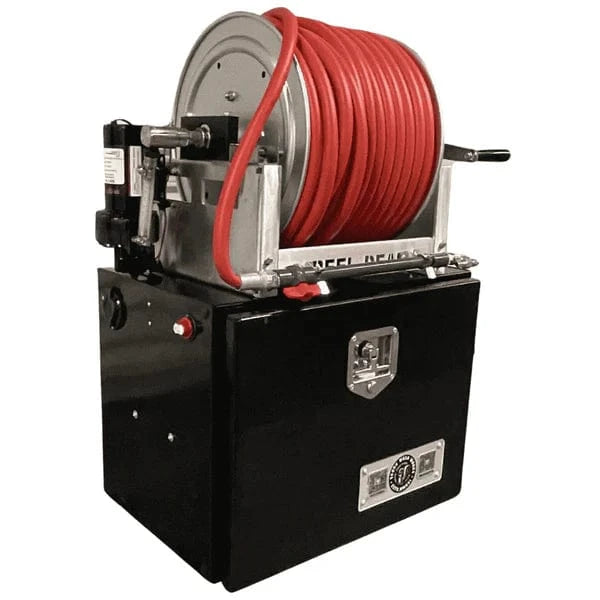
Beyond the rust-proof frame, the skid is built to do real work across both cleaning methods. The Super8 Softwash Pump handles high-volume soft washing with the chemical tolerance that job demands. The Batch-Buster Manifold lets you mix and dispense batches efficiently, and the dual 12" hose reels keep both your soft wash and pressure wash lines organized and ready. The "50/50" name reflects that balance: this is a genuine two-in-one rig for operators who do both soft washing and pressure washing rather than specializing in one.
How does it compare to the common alternative, a traditional steel or aluminum skid you protect with coatings and sprays? A treated steel skid can absolutely last, but only with disciplined, ongoing maintenance. Miss a few end-of-day rinses, let a scratch go untreated, or store it wet a few too many times, and corrosion takes hold. The polymer approach removes that failure mode entirely. You're not maintaining a defense against rust; you simply don't have the vulnerability. Over the life of a rig, that difference compounds into real savings in time, repair costs, and downtime.
Who should choose this skid? It's ideal for professional operators who do a meaningful amount of soft washing, anyone tired of fighting corrosion on a steel frame, and businesses that want to protect their investment with the least possible maintenance. If you're scaling up and want equipment that stays reliable job after job, this is the logical choice.
Who might not need it? If you exclusively do light pressure washing with plain water, never touch sodium hypochlorite, and already own a well-maintained frame, your rust exposure is lower and a corrosion-proof skid may be more capability than you require. And if you enjoy the DIY maintenance side of the trade and don't mind the upkeep, a treated steel setup can serve you. Be honest about your workload and your tolerance for maintenance, and choose accordingly.
To get the most from it, still follow the fundamentals: rinse after chemical jobs to keep the pump and plumbing clear, protect any add-on metal hardware you install, and store it dry. A rust-proof frame removes the biggest problem, but good habits keep the whole system running at its best.
Rust on a pressure washing skid isn't inevitable, but it is relentless if you give it the chance. The chemistry is always working against bare steel, and a working rig offers rust every advantage: water, salt, humidity, and the corrosive vapor of sodium hypochlorite.
If you're dealing with existing rust, remember that pressure washing only removes the surface layer, not the underlying corrosion. Match your removal method to the job: phosphoric acid converters for structural steel, gentle chelating soaks for valuable parts, and household options like vinegar or even cola only for small, light-duty rust. Whatever method you use, always seal the bare metal immediately, or you'll be right back where you started.
For prevention, build the habits that protect steel: rinse after every soft wash job, coat vulnerable metal with an inhibitor like Fluid Film, prime and paint exposed surfaces, and store your equipment dry. Natural options like oils, waxes, and simply keeping metal dry all genuinely help.
But the most powerful lesson here is that the best rust prevention happens at the moment you choose your equipment. Every spray and converter is a workaround for a material that fundamentally wants to corrode. Choosing corrosion-proof construction like the Poly-PRO™ 50/50 Pressure Wash & Soft Wash Skid removes the problem at its source, so instead of maintaining a defense against rust, you can spend your time doing the work that pays. Stop the countdown before it starts, and your equipment will reward you with years of reliable service.