



When Is It Time to Upgrade Your Pressure Washing Rig
|
|
Time to read 16 min
|
|
Time to read 16 min
Every pressure washing operator hits the same wall eventually. The machine that felt like plenty when you started now feels like an anchor. Jobs take longer than they should, you're refilling your tank constantly, and you're watching bigger operators knock out driveways in half the time you need.
That frustration is usually the first real signal that your rig has outgrown its purpose. But frustration alone isn't a reliable metric. Upgrading a pressure washing setup is a business decision, and it deserves a clear-eyed look at performance, reliability, run time, and earning potential before you spend a dime.
This guide walks through exactly how to know when your rig has reached its limit, what specs actually matter, how upgrading changes your economics, and how to make the transition without wasting money. Whether you're running a homeowner-grade unit you've pushed into side-hustle duty or a light commercial machine that can't keep pace anymore, you'll leave knowing precisely where you stand.
Lifespan is the natural starting point, because a worn-out machine forces the upgrade conversation whether you're ready or not.
A consumer-grade electric pressure washer typically lasts around 100 to 300 hours of total use. That sounds like a lot until you realize a busy weekend operator can burn through that in a single season. Gas-powered residential units do better, usually landing somewhere between 500 and 800 hours before major components start failing.
Commercial-grade equipment is a different animal entirely. A properly maintained commercial pressure washer with a quality triplex pump and a reliable engine can run 2,000 to 3,000 hours or more. The pump is usually the limiting factor, and on a good machine, pumps are rebuildable rather than disposable.
Here's the practical translation. If you're using a homeowner unit for paid work, you're not measuring its life in years, you're measuring it in months. The duty cycle simply wasn't designed for daily commercial loads.
Hours on the clock only tell part of the story. Watch for these signals that upgrade time has arrived:
Pump pressure fluctuates or drops even after you've replaced nozzles and checked for leaks.
You're bottlenecked by water capacity, spending more time refilling than washing.
Downtime is eating profit, with repairs stacking up faster than you can schedule work.
You're turning down bigger jobs because your machine can't handle commercial square footage in a reasonable timeframe.
Your run time can't match your route, forcing you to break jobs into awkward chunks.
When two or more of these show up regularly, you've moved past the "maintain and repair" phase into the "upgrade and scale" phase. The machine isn't failing you because it's broken. It's failing you because it was never built for where your business is going.
This is where most operators get the equation wrong. They obsess over PSI and ignore GPM, when GPM is often the number that actually determines how fast you finish a job.
For general residential and light commercial work, a good pressure washer sits in the 2,800 to 3,500 PSI range. That's enough to strip dirt, mildew, and grime off concrete, siding, and hardscapes without special equipment. Anything below 2,000 PSI is really a homeowner cleaning tool, not a production machine.
But PSI only tells you how hard the water hits. GPM (gallons per minute) tells you how much cleaning surface you can cover and how fast you rinse. Two machines at 3,000 PSI will perform very differently if one pushes 2 GPM and the other pushes 8 GPM. The higher-flow unit clears surface area dramatically faster because it's moving more water across the job.
Professionals prioritize flow for exactly this reason. A commercial 8 GPM pressure washer, like the one built into the Starter Skid PRO, doesn't just clean harder, it cleans faster. On large flatwork jobs, that flow rate is the difference between finishing before lunch and grinding into the afternoon.
The simple rule: PSI breaks the bond between dirt and surface, GPM carries the dirt away and covers ground. You need both, but if you're upgrading to earn more, flow is where the money hides.
Yes, but with real caution, and this question reveals an important truth about matching pressure to the surface.
A 3,000 PSI machine is powerful enough to damage automotive paint, chip clear coat, and force water past door seals if you're careless. The pressure itself isn't the problem, technique is. To wash a car safely with a machine in that range:
Use a wide-angle nozzle (40-degree white tip or a soap nozzle), never a 0- or 15-degree tip.
Keep the wand 18 to 24 inches from the surface, not inches away.
Never aim directly at seals, trim, badges, or tires at close range.
Reduce effective pressure by backing off distance rather than blasting at full force.
This matters for upgrade decisions too. A higher-capacity commercial rig is built for driveways, buildings, and fleet work, not delicate detailing. If vehicle work is part of your service menu, you control intensity through nozzle selection and distance, not by buying a weaker machine. A capable rig handles gentle work fine when you use it correctly; a weak machine can never handle heavy work at all.
There are two paths, and choosing the right one saves you money and headaches.
Path one: incremental upgrades to your existing machine. This makes sense when your core unit is sound but underperforming in specific areas. Common improvements include:
Better nozzles. The single cheapest performance boost available. Worn nozzles bleed pressure and waste water. A fresh set of correctly sized tips restores lost force instantly.
A larger water tank. If refilling is your bottleneck, more onboard capacity keeps you working longer between fills.
Upgraded hoses and reels. Longer, higher-quality hose lets you reach more of a property from a single setup, and a proper reel keeps you from wrestling tangles all day.
Pump maintenance or rebuild. Fresh seals and valves can restore a tired pump to near-original output.
Path two: upgrading the entire rig. This is the right move when your machine's fundamental specs, not its condition, are holding you back. You can't add flow to a pump that isn't built for it, and you can't bolt commercial run time onto a residential engine. When the ceiling is structural, you replace the platform.
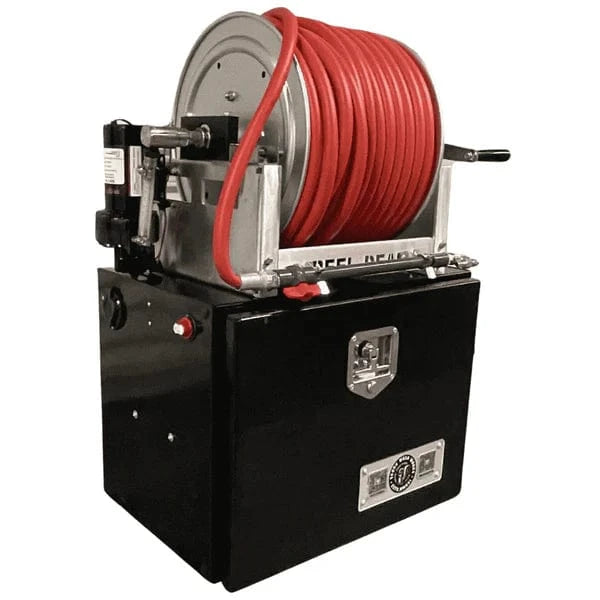
A purpose-built skid system solves the whole equation at once, integrating the pump, engine, water capacity, hose management, and frame into a single unit designed to work together. That's the logic behind a setup like the Starter Skid PRO, which pairs a commercial-grade 8 GPM pressure washer with a heavy-duty SESW polymer frame and a triple reel layout so you're not stitching together mismatched components hoping they play nice.
If you're chasing more power specifically, focus your effort where it actually moves the needle.
First, verify you're not losing pressure you already have. Clogged nozzles, kinked hoses, a clogged inlet filter, or a failing unloader valve rob output before you ever think about upgrading. Fix these first, because they're cheap and often solve the "weak" feeling entirely.
Second, match your nozzle to the task. A smaller orifice increases pressure but reduces flow; a larger one does the opposite. Dialing in the correct tip for each job is how professionals extract maximum effective power from a given machine.
Third, understand the hard ceiling. A pump rated for 3 GPM will never move 5, no matter what you attach. If you consistently need more force and more flow than your machine can physically produce, no accessory fixes that. That's the moment path two, replacing the platform, becomes the smart financial decision rather than throwing money at a unit that's already maxed out.
Run time is one of the most underrated factors in choosing whether to upgrade, because it directly controls how much you can earn in a day.
A commercial-grade gas pressure washer can run continuously for hours, effectively as long as you keep fuel in the tank and water flowing to the pump. The real limits aren't the clock, they're fuel capacity, water supply, and heat management. Consumer machines, by contrast, often carry duty-cycle limits that require cooldown breaks, which is one more reason they buckle under production workloads.
The two things that actually shorten continuous operation are running the pump dry and letting it overheat. Never start or run a pressure washer without a steady water supply, even briefly, because the pump relies on that water for cooling and lubrication. A few seconds dry can score cylinders and destroy seals.
This is where onboard water capacity becomes a genuine earning tool. If your tank runs dry every 30 minutes, your "continuous" run time is a fiction, you're really working in short bursts punctuated by refills. More capacity, paired with more run time, is a core reason operators upgrade to a dedicated skid setup.
Short idling is fine and often useful; prolonged idling is a mistake.
When you're moving between sections of a job, letting the engine idle for a minute or two is perfectly acceptable and easier on the machine than repeated restarts. Most machines have a thermal relief valve or unloader that manages recirculating water during brief pauses.
The problem is extended idling with the trigger off. When water recirculates inside the pump without discharging, it heats up fast. That trapped heat is one of the quickest ways to cook seals and shorten pump life. If you'll be off the trigger for more than a few minutes, shut the unit down or install a system that dumps water to prevent heat buildup. Bottom line: idle briefly between passes, but don't let a machine sit running while you take a lunch break.
Water math surprises a lot of new operators, and it directly shapes how you plan tank size and job routing.
A pressure washer's consumption is simply its GPM times minutes of trigger time. A 4 GPM machine running two full hours uses roughly 480 gallons. An 8 GPM machine used the same way moves about 960 gallons. Real-world usage runs lower because you're not squeezing the trigger every second, but the ceiling is worth understanding.
Here's the strategic point. Higher flow means faster work and higher water demand. That's exactly why serious rigs carry large onboard tanks, you can't rely on a customer's spigot to keep up with a high-GPM machine, and you can't afford to stop working every twenty minutes. Water capacity and flow rate have to be matched, which is another reason integrated skid systems are built as complete packages rather than a pump bolted to whatever tank was lying around.
Operators love asking which brand is "best," but that framing misses how reliability actually works in this industry.
Reliability lives in the components more than the badge. The two parts that determine long-term dependability are the pump and the engine. Quality machines are built around commercial triplex pumps and proven engine platforms, and those core components are what you should evaluate first. A recognizable name wrapped around a low-duty-cycle pump won't outlast a lesser-known rig built with genuinely commercial internals.
When judging reliability, look for:
A commercial-grade triplex pump with ceramic plungers and rebuildable components, not a disposable axial pump.
A proven engine with accessible parts and service support.
A frame built to survive the field. Steel frames rust and heavy metal adds weight; a heavy-duty SESW polymer frame like the one on the Starter Skid PRO resists corrosion, handles vibration, and cuts weight without giving up strength.
Serviceability. The most reliable machine is one you can maintain and repair, not one you throw away when a seal fails.
Instead of asking "what brand," ask "what components, what duty cycle, and how easily can I service it." Answer those and reliability takes care of itself. We've covered pump maintenance in more detail elsewhere, and it's worth studying because a well-maintained commercial pump routinely outlives the machine owner's expectations.
More power. More water capacity. More run time. More earning potential.
This isn’t just an upgrade — it’s a statement. Oh, and did we mention it comers with FREE shipping anywhere in the lower 48!?
But wait, there's more, it also comes with the famous "How to Actually Wash" Video training course is also included at no additional charge!
What Makes It PRO?
Who Is This For? The guy who:
This is still entry-level friendly, It’s just not entry-level performance.
Understanding where the industry is heading helps you upgrade with the future in mind instead of buying for yesterday's standards.
The pressure washing market is growing steadily, driven by residential demand, commercial maintenance contracts, and property managers who increasingly outsource exterior cleaning. That growth is pulling the industry toward higher efficiency and professionalization. Customers expect faster turnarounds, cleaner results, and businesses that look established.
Three trends stand out for anyone deciding whether to scale up:
Flow-based efficiency is winning. As competition tightens, the operators who finish faster win more jobs and protect their margins. High-GPM machines that once seemed like overkill are becoming the standard for serious contractors.
Water reclamation and environmental compliance are rising. More municipalities regulate runoff, especially for commercial work. Rigs designed for professional use increasingly need to accommodate recovery and responsible water handling.
Specialization pays. Fleet washing, commercial flatwork, and soft washing each reward operators who invest in the right equipment rather than trying to do everything with one underpowered machine.
The through-line is simple: the future belongs to operators who treat this as a business and equip accordingly. Upgrading isn't just about handling today's jobs, it's about positioning yourself for the higher-value work that's coming.
Even experienced operators fall into these traps. Avoiding them protects both your equipment and your bottom line.
Chasing PSI while ignoring GPM. This is the most expensive mistake in the industry. Operators buy a high-pressure, low-flow machine and wonder why big jobs take forever. Prioritize flow for production work, and remember that GPM is what covers ground.
Running the pump dry. Even a few seconds without water supply can destroy a pump. Always confirm water is flowing before you start, and never let your tank run empty mid-job.
Letting the machine idle unattended for long stretches. Trapped recirculating water overheats quickly and cooks your seals. Idle briefly between passes, but shut it down for real breaks.
Using a residential machine for commercial work. Homeowner units aren't built for daily duty cycles. You'll burn through them in months, face constant downtime, and lose jobs to faster competitors. If you're earning money, you need commercial internals.
Blasting delicate surfaces at full pressure. Whether it's a car, soft wood, or older siding, forcing full pressure at close range causes damage and callbacks. Control intensity with nozzle selection and distance, not just by pulling the trigger harder.
Piecing together mismatched components. Bolting a random tank and reel onto an underrated pump creates a rig where nothing performs to spec. Integrated systems exist because balanced components outperform cobbled-together setups.
Skipping routine maintenance. Dirty inlet filters, old pump oil, and worn nozzles quietly kill performance. Operators blame the machine when the real culprit is neglected upkeep. A ten-minute checklist prevents most "sudden" failures.
These are the habits and techniques that separate operators who scrape by from those who scale profitably.
Match your nozzle to every task. Keep a full set of tips on hand and change them as jobs demand. The right nozzle extracts maximum effective power from your machine and prevents both damage and wasted time. Professionals change tips constantly; amateurs use one all day.
Set up for reach, not repositioning. Every time you drag your machine to a new spot, you lose time and momentum. Longer hose on a proper reel lets you cover an entire property from fewer setups. A triple reel layout, like the one on the Starter Skid PRO, lets you run pressure, soap, and secondary lines without swapping or tangling, which keeps you moving.
Manage your water like inventory. Know your GPM, calculate your tank duration, and route jobs so you're never caught empty far from a fill point. High-flow machines demand this discipline, and mastering it is what makes high-GPM operation genuinely faster rather than just thirstier.
Warm up and cool down deliberately. Let the engine reach operating temperature before heavy work, and give it a short cooldown before shutdown. This small routine extends component life significantly.
Pre-treat surfaces. Applying the right cleaning solution and letting it dwell before you rinse does more work than raw pressure ever will, especially on organic growth like algae and mildew. Chemistry plus flow beats brute force every time, and it's gentler on the surfaces you're cleaning.
Track your hours and maintenance. Treat your rig like a fleet asset. Log run hours, change pump oil on schedule, and rebuild before failure rather than after. Planned maintenance costs a fraction of emergency downtime during peak season.
Build in redundancy as you scale. Once your income depends on your rig, a breakdown is lost revenue. Serious operators keep spare nozzles, seals, and a service plan so a small failure never becomes a lost workday.
Everything covered in this guide points to a single decision point: the moment your machine's specs, not its condition, become the ceiling on what you can earn. When you're bottlenecked by flow, run time, and water capacity, no accessory or repair fixes the fundamental problem. You need a platform built for production.
The Starter Skid PRO is built for exactly that transition, the operator who's ready to stop dabbling and start dominating. Here's how it answers the specific challenges we've walked through.
It solves the flow problem. The commercial-grade 8 GPM pressure washer directly addresses the single biggest efficiency mistake in the industry, prioritizing pressure over flow. That flow rate covers ground fast, letting you take on larger flatwork and commercial jobs that a low-GPM machine simply can't finish profitably.
It solves the run time and water problem. More water capacity and more run time mean you spend your day washing instead of refilling. The economics of high flow only work when your tank keeps up, and this rig is engineered as a balanced system rather than mismatched parts fighting each other.
It solves the reliability and durability problem. The heavy-duty SESW polymer frame resists corrosion and handles field abuse without the rust and weight penalties of steel. Combined with commercial internals, it's built to log the kind of hours that would destroy a homeowner unit in a single season.
It solves the workflow problem. The triple reel layout keeps your pressure, soap, and secondary lines organized and tangle-free, so you set up once and work efficiently instead of wrestling hoses all day.
Compared to piecing together a homeowner machine with add-on tanks and reels, an integrated skid delivers balanced performance where every component is matched to the others. That balance is what makes the difference between a rig that technically works and one that actually makes you money.
Who should buy it: operators ready to scale from occasional or side-hustle work into serious commercial volume, contractors bottlenecked by their current machine's flow and run time, and anyone whose existing setup is costing them jobs or downtime. If you're turning down work because your rig can't keep pace, this is the upgrade that removes the ceiling.
Who might not need it: the true weekend homeowner cleaning a single driveway a few times a year. If your washing is occasional and personal, a commercial skid is more capacity than your use justifies, and there's no shame in matching the tool to the task. This rig is for people building a business, not maintaining a patio.
To get the most from it, dial in your nozzle set for the mix of surfaces you clean, plan your water routing around that generous flow rate, and stay on top of pump maintenance so those commercial internals deliver the long life they're built for.
Knowing when to upgrade comes down to honest measurement, not frustration. If your machine is nearing the end of its realistic service life, if flow and run time are capping your earnings, or if downtime is eating into peak season, the signals are clear.
Remember the core principles: prioritize GPM alongside PSI, never run your pump dry, idle only briefly, match pressure to the surface, and evaluate reliability by components and serviceability rather than brand name. Those fundamentals protect your investment and your reputation no matter what equipment you run.
The pressure washing industry rewards operators who treat it like a business and equip for where they're going, not where they've been. When your current rig becomes the thing holding you back, upgrading to a purpose-built platform like the Starter Skid PRO isn't an expense, it's the investment that unlocks the higher-value work already within your reach. Make the move when the numbers tell you to, and your equipment will finally match your ambition.